
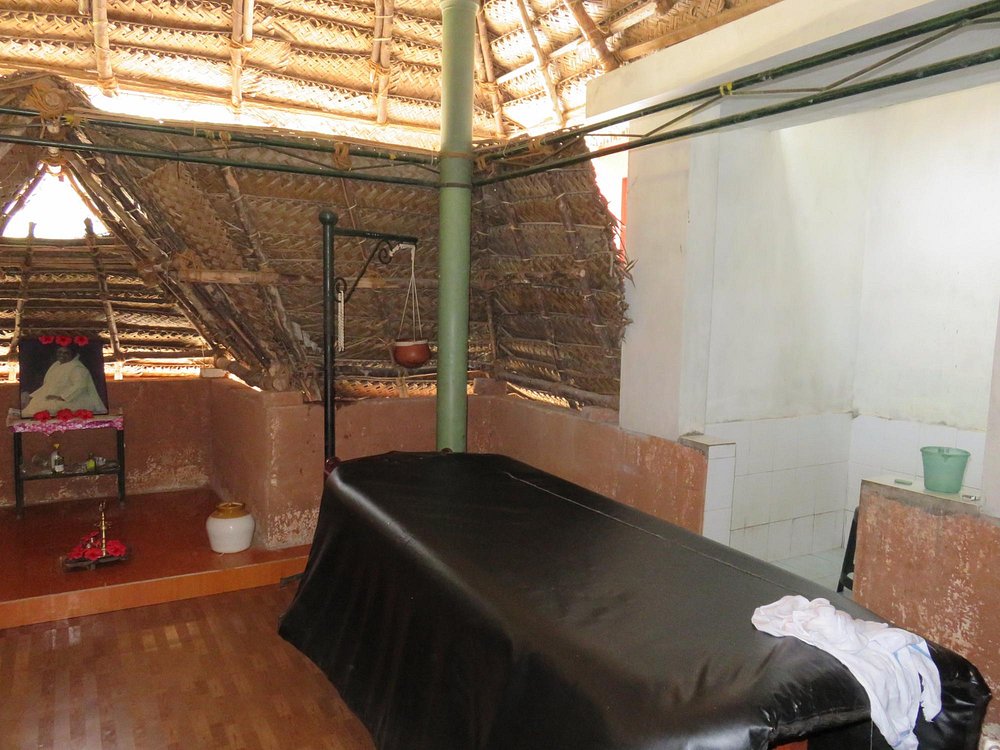
There is a moment, in the hands of a skilled practitioner, when you feel a single point on the body release — and the breath that follows seems to come from somewhere deeper. That moment is the heart of Kalari Uzhichal, the therapeutic massage born from Kerala’s warrior tradition, and it lives or dies on a sound understanding of kalari marma points — the vital energy centres mapped by generations of masters who knew the body as both a battlefield and a temple.
If you have felt drawn to learn this art — not as a weekend curiosity but as a craft to carry — we invite you to slow down and understand what you are really stepping into. Here, near Vellayani Lake in Kovalam, this tradition is taught with patience, reverence, and the close attention it deserves.
What are kalari marma points?
In the Ayurvedic and martial traditions of Kerala, the body is understood to hold subtle junctions where flesh, bone, nerve, and breath converge. These are the marma points (marmas) — vital spots where life-force (prana) gathers. The kalari marma points are the specific subset known to Kalaripayattu, the ancient martial art of the region; the same knowledge that taught a warrior where a strike could disable also taught the healer where a touch could restore.
Classical texts describe a network of these points across the body, each with its own depth, direction, and sensitivity. Kalaripayattu itself is recognised among the oldest surviving fighting systems in the world, and you can read a fuller account of its history and lineage in the overview of Kalaripayattu on Wikipedia. For the therapist, this map is not a weapon but a guide — a way of reading the body that turns a general massage into precise, intentional work.
It helps to understand a few distinctions that beginners often blur together:
- Marma: the broad Ayurvedic concept of vital points found across the whole tradition of healing.
- Kalari marma: the points as understood and applied within Kerala’s martial lineage, where precision was once a matter of survival.
- Kalari Uzhichal: the therapeutic massage that puts that knowledge to gentle, healing use.
Why the kalari marma points matter in healing
A massage that ignores these centres can still feel pleasant. But the depth of Kalari Uzhichal comes from working with the body’s own architecture rather than over it. Practitioners traditionally use the points to:
- Release stagnation: gentle, knowing pressure on a marma may help mobilise areas where tension and fatigue have settled.
- Restore mobility: foot-pressure and rhythmic strokes along the limbs can help ease stiffness and support a freer range of movement.
- Calm the nervous system: because many points sit at nerve junctions, attentive work is traditionally used to settle an over-stimulated mind and body.
- Support recovery: athletes, dancers, and martial artists have long turned to this work to recover from strain and overuse.
None of this is an exaggerated promise. Marma work is a traditional practice, and any persistent pain or condition deserves a qualified medical opinion alongside it. What the tradition offers is care that is precise, embodied, and deeply human — and that, in itself, can be restorative.
Learning to read the body
To work safely with the kalari marma points, you first have to learn to feel them. This is why the tradition is taught by hand, not from a chart alone. A student spends time understanding the body’s constitution (Prakriti), the qualities of the medicated oils, and the direction in which energy is meant to move along each channel.
Much of Kalari Uzhichal is performed with the feet — the therapist suspended from a rope above the table, using controlled body weight to deliver long, deliberate strokes. It looks effortless. It is anything but. Behind it lies a trained sense of pressure, timing, and the precise location of each vital point, so that strength is always married to sensitivity.
There is also a matter of responsibility. Because these points sit near nerves and joints, careless or forceful work can do harm rather than good. A serious training therefore begins with what not to do — which points to approach softly, when to avoid pressure altogether, and how to read a body that is guarding or unwell. Restraint, you come to see, is as much a skill as touch. This caution is why the tradition has always passed from teacher to student in person, never from a manual alone.
Inside the Kalari Uzhichal Certification
Our Kalari Uzhichal Certification is built for those who want to learn this work properly — with the kalari marma points at its centre rather than as an afterthought. Under experienced practitioners, you move from theory into the felt experience of the technique, learning posture, pressure, oil selection, and the rhythm that distinguishes a true Kalari treatment from an ordinary massage.
The course suits a range of people — therapists wanting to deepen their hands, yoga teachers seeking a richer understanding of the body, and sincere beginners ready to give the tradition the time it asks for. If you are mapping out a broader path of study, it sits naturally alongside the rest of our courses, and many students pair it with the foundational skills taught in the Massage Course.
A tradition best experienced, not just studied
Before you ever lay hands on another person, it helps to receive the work yourself. Feeling skilled pressure move across your own vital points teaches more than any lecture — you learn what release feels like, where the body holds, and how patience changes everything. Experiencing Marma therapy as a guest is, for many, the moment the whole tradition finally makes sense.
This is also why we keep the setting quiet. With only eight rooms and the lake nearby, there is space to be unhurried — to practise, to rest, to return inward, and to let the learning settle in the body rather than only the notebook.
If this calls to you, come and learn it where it has always belonged — in Kerala, the soil of Kalaripayattu and the living home of marma. Whether you arrive as a curious beginner or a seasoned therapist, the work of the kalari marma points will meet you exactly where you are, and ask only your attention and your care.
Continue Exploring
- Kalari Massage Benefits: What Uzhichal Is and Is Not
- Kalari Massage for Athletes: Kerala's Warrior Bodywork
- Kalari Massage vs Ayurvedic Massage: How Kerala's Two Healing Touches Differ
- Kalari Uzhichal Benefits: The Healing Art of Kerala's Warriors
- The Kalari Uzhichal Certification Course: Learning Kerala's Healing Touch


