
There is a particular kind of stillness that lives in the hands of a healer who knows the body's hidden lines — the vital points where breath, blood, and intention seem to gather. To learn that touch is not to memorise a technique, but to slow down until your own awareness sharpens. A kalari uzhichal certification course is an invitation into exactly this: the ancient bodywork of Kerala's warrior tradition, practised not as performance but as care.
If you have felt drawn to healing work — perhaps as a yoga teacher, a therapist, or simply a curious traveller who wants their hands to mean something — this is a path worth walking slowly. Here in Kovalam, near the quiet shore of Vellayani Lake, we hold space for that learning.
What is Kalari Uzhichal?
Kalari Uzhichal is the therapeutic massage embedded within Kalaripayattu, the martial art of Kerala — widely regarded as one of the oldest fighting systems still practised today. You can read more about its origins in the broader tradition of Kalaripayattu, where physical training and healing have always travelled together. Warriors were not only taught to strike; they were taught to mend, because a body pushed to its limits needs deep restoration.
The massage itself is distinctive. It often uses the practitioner's feet, controlled by ropes suspended from the ceiling, alongside the hands — allowing a depth of pressure that the palms alone cannot reach. Warm medicated oils soften the tissue, while the work follows the body's vital energy points (marma) and channels. The aim is to release stored tension, improve flexibility, and coax the body back into balance.
Why train in the kalari uzhichal certification course?
People come to a kalari uzhichal certification course for many reasons, and most arrive carrying more than one. Some wish to add a rare and powerful skill to an existing healing practice. Others feel a quiet pull toward Kerala's living traditions and want to learn at their source rather than from a screen.
- For yoga and movement teachers: the work deepens your understanding of fascia, alignment, and the body's vital points (marma), enriching how you guide others.
- For bodyworkers and therapists: it offers a foot-pressure and rope-assisted technique that few practitioners outside Kerala have trained in directly.
- For seekers: it is, quite simply, a U-turn inward — a chance to develop presence, patience, and a steadier hand.
Whatever brings you, the certification gives your learning shape and recognition. It marks not the end of study but a threshold — the point at which your hands have been trained well enough to begin holding others with confidence and care.
What you can expect to learn
A thoughtful training in this tradition moves from understanding to embodiment. You learn the why before the how, so that every stroke carries intention rather than imitation. Broadly, the learning unfolds across a few threads woven together:
- The map of the body: the vital points (marma), the energy channels, and how Ayurveda reads each person's constitution (Prakriti).
- Oils and preparation: choosing and warming the right medicated oils, and preparing the body and the space before any touch begins.
- Hand and foot technique: the sequences, the rhythm, the rope-assisted foot pressure, and the discipline of controlled, even strokes.
- Safety and care: when the work is appropriate, when it is not, and how to adapt to each body that comes to you.
Much of this overlaps gently with related healing arts. If you are drawn to the energy-point dimension, our work in Marma therapy explores the same vital points from a treatment perspective, and may deepen what you learn here.
Learning Ayurveda at its source
There is something irreplaceable about learning a Keralan tradition in Kerala — in the climate, the cuisine, the cadence of life that shaped it. Days here move to a sattvic (pure, vegetarian) rhythm: nourishing food, early light, and long stretches of quiet that let what you study actually settle.
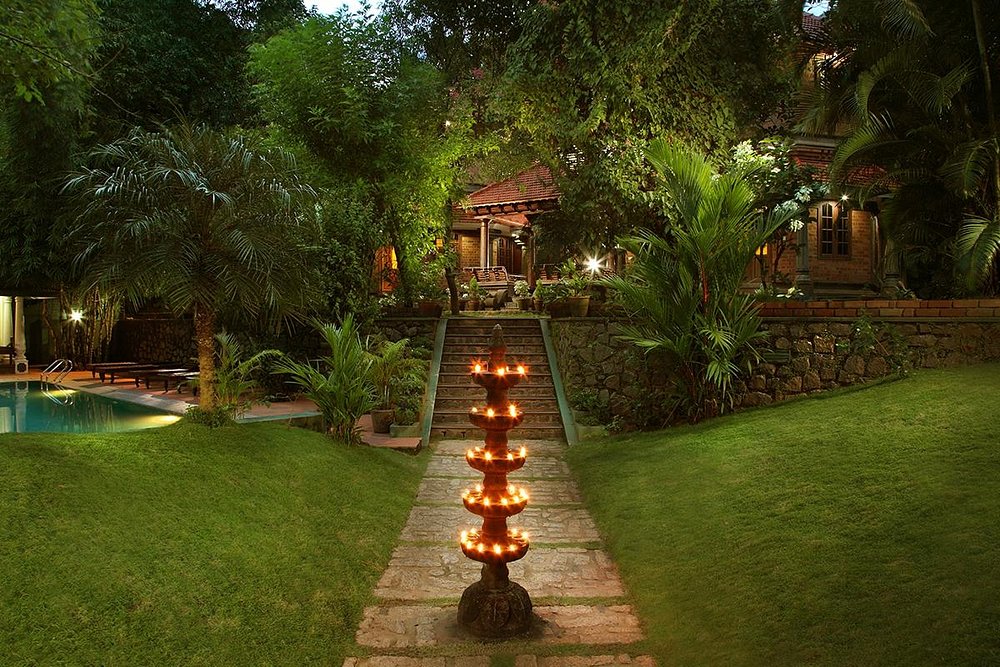
Amrutham is an intimate place — only eight rooms — which means learning happens in small numbers, with real attention rather than a crowded classroom. Our philosophy of M·A·Y (Meditation, Ayurveda, Yoga) frames everything: you are not just acquiring a skill, you are returning to a calmer, clearer, more grounded version of yourself while you do.
How it fits alongside our other courses
The kalari uzhichal certification course sits within a wider family of trainings. Many who study with us are weaving together several strands of Ayurvedic and bodywork education over time. You might explore the full range of our courses to see how the pieces complement one another.
- Foundational hands-on skill: our Massage Course grounds you in classical Ayurvedic oil massage (Abhyanga) and is a natural companion to kalari work.
- Deeper clinical training: the Panchakarma certification opens the world of detoxification and classical therapies for those who wish to go further.
There is no single right order. Some begin with massage and move toward the martial tradition; others arrive specifically for the kalari uzhichal certification course and discover the rest along the way. We are happy to talk through what suits where you are.
A word on responsibility
Bodywork of this depth deserves honesty. It is traditionally used to ease stiffness, support recovery, and restore flexibility — and many feel its benefits keenly. But it is not a remedy for everything, and it is not suitable in every condition. Pregnancy, certain injuries, and some chronic conditions call for caution or for a different approach altogether. A good practitioner learns not only what to do, but when to pause and when to refer onward.
So we encourage you to learn responsibly, to consult qualified practitioners where appropriate, and to hold your future clients with the same care you would want for yourself. The tradition rewards patience: the more honestly you study, the more your touch can be trusted.
When you train this way — slowly, attentively, in the place where the tradition was born — the certificate becomes almost secondary. What you carry home is a steadier presence and hands that know how to listen. If that is the kind of learning you are seeking, we would be glad to welcome you to Amrutham.
Continue Exploring
- Kalari Uzhichal Course Content: Inside Kerala's Healing Art
- Kalari Uzhichal for Injury Recovery: Learning Kerala's Healing Touch
- Kalari Uzhichal: Learning Kerala’s Warrior Bodywork
- Learn Kalari Uzhichal in Kerala: A Warrior's Healing Art
- Learn Panchakarma in Kerala: Tradition, Discipline and Daily Practice


