
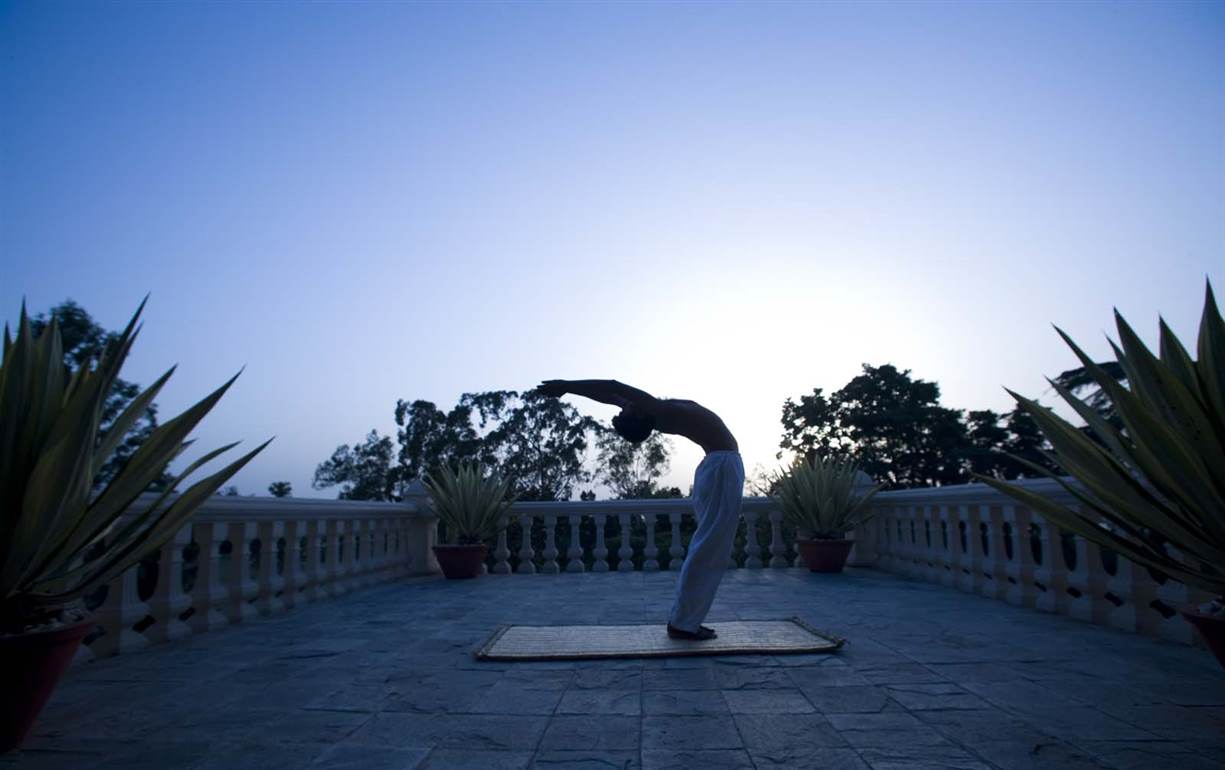
There is a moment, early in the morning, when the light is still soft and the world has not quite begun to ask anything of you. Surya Namaskar — the Sun Salutation — belongs to that moment. It is a flowing sequence of postures, linked by breath, that many people use to greet the day, warm the body, and quietly arrive in themselves before everything else begins.
The name itself is an invitation. Surya means sun; namaskar comes from namaste — a respectful bow, a greeting offered with the whole self. So the practice is, in the most literal sense, a way of saying hello: to the light, to the day, and to the body that carries you through it. You do not need to be flexible, experienced, or even particularly awake to begin.
What Surya Namaskar Actually Is
Surya Namaskar is not a single posture but a short, repeating cycle — usually twelve linked movements that flow from standing, down toward the earth, and back to standing again. Each movement pairs with an inhalation or an exhalation, so the sequence becomes a kind of moving meditation rather than a set of exercises. You rise as you breathe in; you fold as you breathe out. The breath leads, and the body follows.
The sequence has deep roots in the yogic tradition and is documented widely, including in this overview of Surya Namaskara. Different schools order the postures slightly differently, and that is part of its charm — it has been adapted, gently, for centuries. What stays constant is the shape of the journey: a salutation that bows toward the ground and returns, again and again, like a tide.
The Flow of the Sun Salutation, Step by Step
You do not need to memorise the Sanskrit names to feel the rhythm of the Sun Salutation. Think of it as one continuous wave, with the breath marking each turn. A typical round moves through these moments:
- Prayer pose (Pranamasana): stand tall, palms together at the heart — a quiet beginning.
- Raised-arms pose (Hasta Uttanasana): inhale, sweep the arms overhead, lengthen.
- Forward fold (Padahastasana): exhale, fold gently toward the legs; soften the knees.
- Equestrian pose (Ashwa Sanchalanasana): inhale, step one foot back into a low lunge.
- Plank / Stick pose (Dandasana): hold a straight line, strong and steady.
- Eight-point salute (Ashtanga Namaskara): lower knees, chest, and chin toward the earth — the bow at the centre of it all.
- Cobra (Bhujangasana): inhale, lift the chest, opening the front of the body.
- Downward dog (Adho Mukha Svanasana): exhale, lift the hips into an inverted V.
- The return: step forward, fold, rise with the arms, and come back to the heart.
One full round usually leads with one leg, the next round with the other, so the body stays balanced. There is no prize for speed. Slow rounds and quick rounds each have their place — and a beginner is always welcome to pause anywhere along the way.
The Benefits of Practising Surya Namaskar
Because the Sun Salutation moves the whole body through a complete range — folding, extending, bearing weight, opening the chest — it is traditionally valued as a gentle, all-in-one practice. Done mindfully and within your own comfort, it may support the body and mind in several ways:
- Mobility and warmth: the flowing transitions gently warm the joints and lengthen the muscles, which is why it is often used to begin a practice.
- Breath awareness: pairing each movement with an inhale or exhale draws the breath deeper and steadier — a small, portable form of calm.
- Steadiness of mind: the repetition turns attention inward, so the sequence can feel as meditative as it is physical.
- Strength and balance: holding plank, cobra, and the lunges, over time, can build quiet, even strength through the core and limbs.
- A sense of rhythm: practised in the morning, it can become a grounding ritual that frames the rest of the day.
These are tendencies, not promises. The Sun Salutation is not a cure for anything, and if you live with an injury, high blood pressure, are pregnant, or have any medical concern, it is wise to consult a qualified teacher or doctor before beginning. Listen to your body first; the practice will meet you where you are.
A Gentle, No-Pressure Approach for Beginners
If you are new to Surya Namaskar, the single most useful thing to remember is this: let the breath lead the movement. When you cannot tell whether to inhale or exhale, breathe naturally and keep going. Grace comes later; presence comes first.
- Modify freely: bend your knees in the forward fold, drop your knees in plank, rest in child's pose whenever you need. Every posture has a softer version.
- Begin with two or three rounds: a small, kind practice you actually return to is worth far more than an ambitious one you abandon.
- Move slowly: let each breath finish before the next movement begins. The sequence is not a race against the clock.
- Notice, don't judge: stiffness on one side, a wobble in balance — these are simply information, not failure.
Learning the flow alongside a teacher makes all the difference — a gentle adjustment, a word about your breath, and the postures settle into the body in a way that no video quite manages. That is why so many people choose to learn it within a structured, unhurried setting, where time is finally on their side.
Practising the Sun Salutation at Amrutham
At Amrutham, our intimate retreat in Kovalam, Kerala, mornings begin softly — often on a mat, with the light still gentle and the day still ahead. Yoga here is part of our wider philosophy, M·A·Y (Meditation · Ayurveda · Yoga), and it sits within the A.C.E. framework — Awareness, Contentment, Equanimity — that shapes every stay. The Sun Salutation, for many of our guests, becomes the first thread of a quieter way of living.
You can explore our guided Yoga Package and our wider Yoga Offerings, where postures, breath, and stillness are taught with patience rather than pressure. If you would like to go deeper, our Yoga Teacher Training opens the tradition more fully; and for those who wish to pair movement with rest and renewal, the Prana Package weaves yoga together with authentic Ayurveda.
Surya Namaskar asks for very little: a small patch of floor, a few minutes, and your willingness to begin. Practised over time, this simple greeting to the sun can become a daily return to yourself — clearer, calmer, and more grounded. Whenever you are ready, we would be glad to greet the morning with you.


