
If sitting cross-legged with your eyes closed has always felt like a small act of torture, walking meditation may be the practice you have been waiting for. It asks nothing of your stillness — only your attention. Step by step, breath by breath, it turns the most ordinary act of moving through the world into a quiet, grounding form of awareness.
For restless minds and bodies that simply will not settle on a cushion, this is freeing. You do not have to fight your fidgeting. You learn, instead, to let movement itself become the anchor — and in doing so, you discover that stillness was never about holding the body frozen. It was always about being fully here.
What walking meditation actually is
Walking meditation is a contemplative practice with deep roots in the Buddhist tradition, where it is often called kinhin — a slow, deliberate walk used to balance long periods of seated meditation. The principle is simple: rather than focusing on the breath or a mantra alone, you bring gentle, sustained attention to the act of walking. The lift of a foot, the shift of weight, the press of the sole against the earth — each becomes an object of awareness.
It is part of a wider family of mindfulness practices that train the mind to rest in the present moment. Where seated meditation can feel like a battle against a busy mind, walking gives that restlessness somewhere to go. The body is occupied, the senses are engaged, and the mind — almost by accident — begins to soften and settle.
This fits naturally into the M·A·Y philosophy — Meditation · Ayurveda · Yoga — that shapes every day at Amrutham. Meditation here is never one rigid posture; it is a way of paying attention that you can carry from the cushion to the garden path and, eventually, into the rest of your life.
Why it suits restless people who can't sit still
Many people quietly conclude that they are "bad at meditation" because they cannot sit still. The truth is gentler: some nervous systems simply need movement to feel safe enough to soften. If that sounds like you, this practice may be a kinder doorway in.
- It gives restlessness a channel: instead of suppressing the urge to move, you fold that energy into the practice itself.
- It is easier on the body: no aching knees, no numb legs, no clock-watching — a relief for anyone who finds long sitting genuinely uncomfortable.
- It engages the senses: birdsong, breeze, warm ground underfoot — these natural anchors are vivid and easy to return to when the mind drifts.
- It is portable: a hallway, a quiet lane, a garden loop — anywhere you can take ten slow steps, you can practise.
This is also why it pairs so well with our yoga sessions and unhurried Ayurvedic rhythms. Movement and stillness are not opposites here; they are two ways of arriving at the same quiet, attentive presence.
How to practise walking meditation, step by step
You need no equipment and very little space — a flat, safe stretch of about ten to twenty paces, where you can walk slowly back and forth without worrying about traffic or onlookers. A garden path, a quiet beach, or a stretch of lakeside works beautifully.
- Stand and arrive: pause at one end of your path. Feel your feet on the ground and take two or three slow breaths to settle.
- Begin slowly: walk far more slowly than usual. Let one foot lift, move, and place itself fully before the other begins.
- Name the movement: silently note "lifting… moving… placing" with each step. This gentle labelling keeps the mind from wandering.
- Feel the contact: notice the heel meeting the ground, the roll through to the toes, the shift of weight — the whole quiet mechanics of a single step.
- Turn with awareness: at the end of your path, pause, breathe, turn slowly, and begin again in the other direction.
- Return, gently: when your attention drifts — and it will — simply notice, and come back to the next footfall. No judgement, no scolding.
Begin with ten minutes. The pace is meant to feel almost unnaturally slow at first; that slowness is the point. You are not trying to get anywhere. You are simply learning to be fully present for the journey of a single step, then the next.
What the practice may offer body and mind
As with any contemplative practice, the gifts of walking meditation tend to be quiet and cumulative rather than instant. It is not a cure for anything, and it is no substitute for professional care when you need it — but as a daily habit it is traditionally valued, and increasingly studied, for the way it can steady the mind and ease a tightly wound nervous system.
- A calmer mind: regular practice may help quieten mental chatter and support a more settled mood.
- Gentle release of tension: slow, mindful movement can help relieve the physical bracing that stress leaves in the shoulders, jaw, and breath.
- Better focus: training attention on each step is, in effect, a workout for concentration you can carry into the rest of your day.
- A friendlier relationship with meditation: for many restless people, this is the practice that finally makes stillness feel possible.
In Ayurvedic terms, gentle, rhythmic movement can be soothing for a restless, airy constitution (Vata) — the very temperament that often finds sitting still so hard. It is one small reason our retreats weave movement and stillness together rather than treating them as separate disciplines.
Practising walking meditation by Vellayani Lake
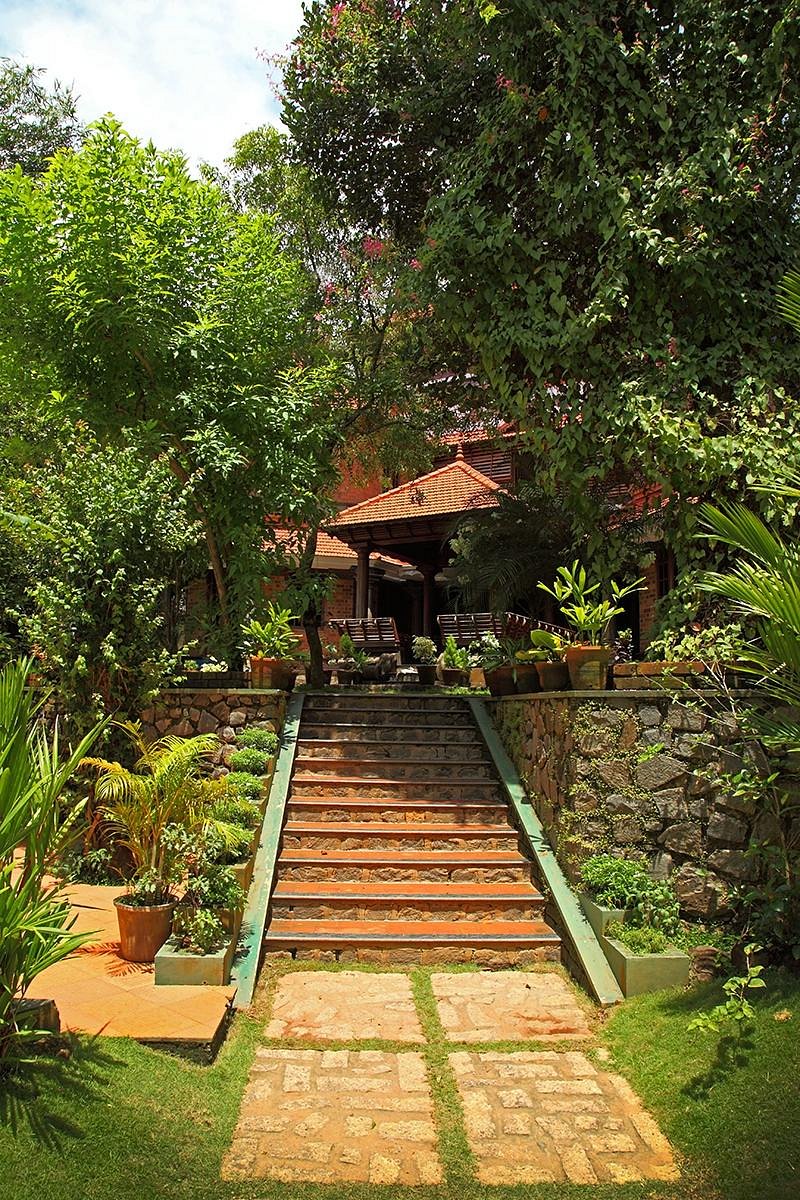
Setting matters more than we admit. It is far easier to find stillness in movement when the world around you is already quiet. At Amrutham, our gardens and the soft fringe of Vellayani Lake offer exactly that — unhurried paths, the murmur of water, the green hush of Kerala mornings. With only eight rooms, the grounds are rarely crowded, so a slow, mindful walk feels entirely natural here.
Imagine beginning your day before the heat arrives: bare feet on cool earth, the lake catching the first light, your attention resting softly on each step. This is the kind of unforced presence a stay here is designed to nurture — a true U-turn inward, returning you to a clearer, calmer, and more grounded sense of yourself. Tucked just thirty minutes from Trivandrum yet a world away in pace, it is a sanctuary built for precisely this kind of slowness.
If the idea of trading noise for birdsong appeals, our quietest, most inward-facing programme may be the natural next step. Built around silence, gentle movement, and meditation, it gives walking meditation the space it deserves to become a daily practice rather than an occasional experiment.


