
There are days when the mind will not settle — when worry loops, the shoulders climb towards the ears, and the breath turns shallow without our noticing. On days like these, a gentle, breath-led vinyasa flow for stress relief can feel less like exercise and more like coming home to yourself. Not to fix anything. Simply to soften, and to remember how it feels to be at ease.
At Amrutham, here in the quiet near Vellayani Lake in Kovalam, Kerala, we hold yoga as one of three companions on the path — Meditation, Ayurveda and Yoga, our M·A·Y philosophy. Movement is never the goal in itself. It is a doorway. Below, we share how a flowing practice can help unwind tension, and how to approach it with care.
What a vinyasa flow for stress relief actually does
Vinyasa simply means linking movement to breath, so that each posture (asana) arrives on an inhale or releases on an exhale. The practice becomes a moving meditation — the attention has somewhere steady to rest, and the restless mind is given a single, gentle task. This is the quiet genius of it.
When we are stressed, the nervous system tilts towards its alert, fight-or-flight setting. A slow, mindful flow encourages the opposite — the rest-and-digest response, governed by the vagus nerve. Long exhalations, in particular, are traditionally used to invite calm. The broad benefits of yoga for relaxation and wellbeing are increasingly documented in research and clinical practice, though yoga is best understood as support for a balanced life rather than a remedy for any condition.
What a flowing practice may offer:
- A slower breath: deliberate, even breathing can ease the body out of its tense, guarded state.
- Released tension: gentle movement loosens the neck, shoulders and hips where stress tends to settle.
- A quieter mind: following the breath gives anxious thoughts less room to circle.
- A sense of return: the practice can leave you feeling clearer, calmer, and more grounded.
A simple vinyasa flow for stress relief you can try
You need very little — a quiet corner, a mat, and a few unhurried minutes. Move slowly. Let the breath lead, not the posture. If anything pinches or strains, ease off; this is meant to feel kind.
- Settle: sit or stand still. Take five slow breaths, letting the exhale be a little longer than the inhale.
- Cat–Cow: on hands and knees, arch on the inhale, round on the exhale. Repeat six times, letting the spine wave gently.
- Downward Dog to a soft lunge: lengthen the back of the legs, then step one foot forward and let the hips open. Breathe here.
- Forward fold: stand and fold gently from the hips, knees soft, head heavy. Let the neck release.
- Rest: lie down for a few minutes in stillness (Savasana), simply noticing the breath.
Even ten minutes, practised with attention, can shift the texture of a difficult day. Consistency matters more than intensity — a little, often, is plenty.
Breath is the heart of the practice
If you take only one thing from this, let it be the breath. In the yogic tradition, breath regulation (Pranayama) is held to steady the mind and the life-force (prana) that moves through us. A flowing practice without conscious breath is simply movement; with it, the same shapes become a balm.
Try this on its own, away from the mat: breathe in for a count of four, and out for a count of six. The longer exhale is the part that signals safety to the nervous system. Repeated for a few rounds, it can quiet a racing mind before sleep, before a difficult conversation, or in any moment that asks for steadiness.
This emphasis on breath and inward attention is also why we pair movement with stillness at Amrutham. Our Prana package places the breath at the centre, weaving Pranayama and meditation through the days so that calm becomes less a fleeting experience and more a quiet habit.
When stress runs deeper than a hard week
Sometimes tension is not the weather of a single week but a season we have been living in for too long — sleep that will not come, a body that feels wrung out, a mind that cannot rest. Here, Ayurveda offers a wider view. It looks at constitution (Prakriti), at digestive fire (agni), and at the accumulated residue of stress and poor rest that it calls toxins (ama).
Classical therapies traditionally used to calm the nervous system — among them the gentle, continuous pouring of warm oil over the forehead (Shirodhara) and rhythmic oil massage (Abhyanga) — can support deep rest and ease. When yoga and Ayurveda meet, movement and bodywork begin to reinforce one another. Our Signature Retreat is built around exactly this meeting, drawing the three threads of Meditation, Ayurveda and Yoga into a single, unhurried arc.
If you are managing a diagnosed condition, please treat these practices as companions to professional care, not a replacement for it — and speak with a qualified practitioner before beginning anything new.
Practising in a place that holds you
There is a difference between squeezing a flow into a crowded morning and stepping fully out of the noise for a while. Much of what keeps us tense is simply the relentlessness of ordinary life — the pings, the lists, the sense of always being slightly behind. A retreat removes that backdrop, and the practice deepens almost on its own.
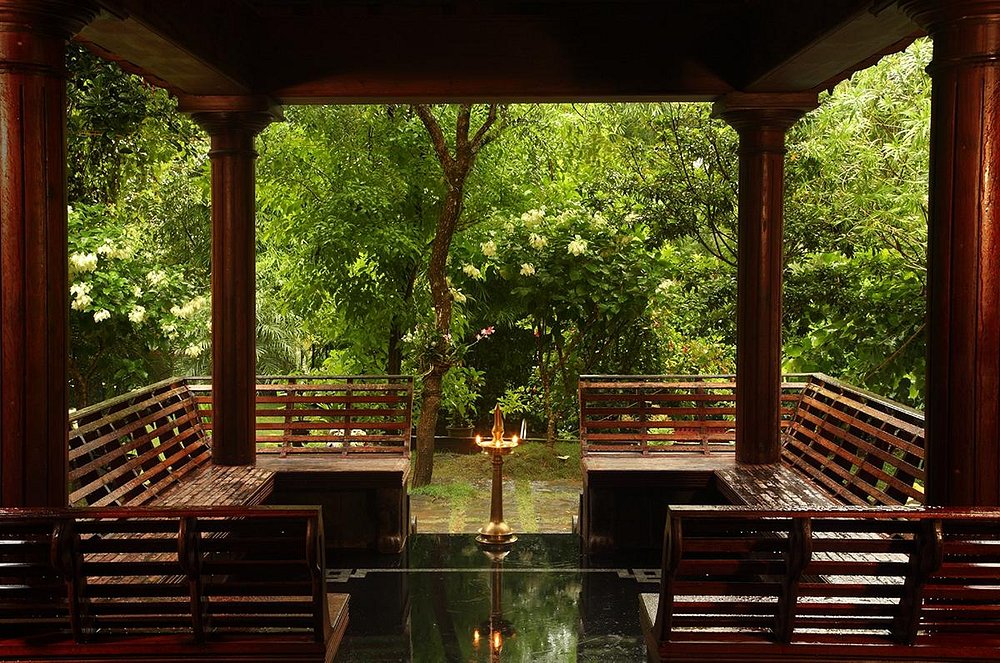
Amrutham is intentionally small and quiet — only eight rooms, set in nature, with sattvic (vegetarian) food and unrushed days. We think of a stay as a U-turn inward: a return to yourself. Within that setting, you can explore the breath-led yoga that suits you among our wider yoga offerings, guided rather than rushed, so the calm you find can travel home with you.
However stretched you feel as you read this, know that ease is closer than it seems — often just a few conscious breaths away. A gentle vinyasa flow for stress relief is one small, kind beginning. When you are ready to give it room, we would be glad to walk alongside you.


