
There is a particular kind of tiredness that sleep cannot reach. It lives behind the breastbone, in the set of the jaw, in shoulders that never quite come down. You may not have a name for it — only the sense that something inside is held, waiting, unspoken. Yoga for emotional release is the gentle practice of letting that something move at last, of allowing the body to soften what the mind has been guarding for a very long time.
At Amrutham, tucked among the palms near Vellayani Lake in Kovalam, we meet this quietly. Not with intensity or performance, but with patience — the unhurried unfolding of breath, posture, and stillness that lets feeling find its way to the surface and, finally, out.
Why the body holds what the mind forgets
Emotion is not only a thought; it is a physical event. Grief tightens the chest, anxiety quickens the breath, anger braces the muscles for a fight that never comes. When we are unable to fully feel or express these states, the body tends to keep them — as tension, as shallow breathing, as a posture of protection we carry for years without noticing.
The relationship between movement, breath, and the nervous system is well documented. Practices that lengthen the exhalation and gently mobilise the spine and hips can shift us out of a state of alertness and into one of rest — what the science of the vagus nerve describes as a return to safety. Yoga does not erase what we feel. It changes the conditions of the body so that what is held can be felt safely, and then released.
How yoga for emotional release actually works
There is nothing dramatic about it, and that is the point. Emotional release in yoga is rarely a flood; more often it is a small loosening — a long sigh, an unexpected stillness, a tear that arrives without a story attached. The practice simply makes room.
- Breath (Pranayama): Conscious breathing — particularly a slow, extended exhale — calms the nervous system and signals to the body that it is safe to let go.
- Hip and chest opening: Many of us store tension in the hips and the heart-space. Gentle, well-supported postures here can bring unexpected feeling to the surface.
- Stillness and rest: In held poses and in final relaxation (Savasana), the body lowers its guard, and emotion that was braced against often softens.
- Witnessing (Sakshi): Learning to observe a feeling without being swept away by it — the heart of our A.C.E. framework of Awareness, Contentment, and Equanimity.
None of this is forced. We do not chase catharsis or treat tears as a goal. Yoga for emotional release works precisely because it is allowed to be slow, optional, and entirely yours.
A gentle sequence you can begin with
If you are curious to feel the texture of this practice before you travel, here is a soft, accessible sequence. Move slowly, stay warm, and stop the moment anything feels sharp rather than tender. This is an invitation, not an instruction.
- Extended exhale: Sit comfortably. Breathe in for a count of four, out for a count of six or eight. Five minutes is enough to begin settling the nervous system.
- Supported reclined butterfly: Lie back with the soles of the feet together, knees wide, a cushion under each thigh. Let the chest open and rest here for a few minutes.
- Gentle spinal twist: On your back, drop both knees to one side and let the breath move into the ribs. Repeat on the other side.
- Child's pose (Balasana): Fold forward over the knees, forehead resting, arms soft. A posture of letting the front of the body be held.
- Rest: Finish lying still for several minutes, doing nothing at all. Whatever surfaces is welcome.
Be kind with yourself afterwards. Emotional movement can leave you tender or unexpectedly light. Both are honest, and both are fine.
Where Ayurveda meets yoga for emotional release
In our philosophy of M·A·Y — Meditation, Ayurveda, and Yoga — these are not separate offerings but one continuous path inward. Ayurveda understands that unprocessed emotion can settle in the body much as physical residue (ama) does, clouding clarity and weighing on the spirit. The classical therapies we offer work alongside the practice on the mat.
The warm, rhythmic oil massage (Abhyanga) quietens an overactive nervous system before it can grip. The steady stream of warm oil across the forehead in Shirodhara settles a restless mind into something close to stillness. Sattvic (vegetarian) food, early nights, and the sound of water and birdsong all create the conditions in which release becomes possible. You can read more about how we weave these threads together across our yoga offerings, where breath, posture, and therapy support one another.
For those who feel they are carrying more than usual, the deeper, breath-led work of the Prana package goes further into the energetics of breath and feeling — a fuller immersion for when a few sessions are not quite enough.
Coming with care: what to expect, and when to seek support
We want to be honest and responsible here. Yoga can be a profound support for emotional wellbeing, and it is traditionally used to steady the mind and ease the body — but it is not a substitute for professional care. If you are living with grief, trauma, or a mental-health condition, please continue to work with a qualified therapist or doctor, and let us know what would help you feel safe.
- Go slowly: There is no schedule for feeling. Some days nothing moves, and that is its own kind of progress.
- Choose presence over performance: How deep a posture goes matters far less than how present you are within it.
- Let the setting do its work: A quiet, unhurried environment — the heart of all of our retreats — makes softening far easier than a busy life allows.
This is the U-turn inward we speak of so often: not a journey away from your life, but a quiet return to yourself — clearer, calmer, and more at home in your own body.
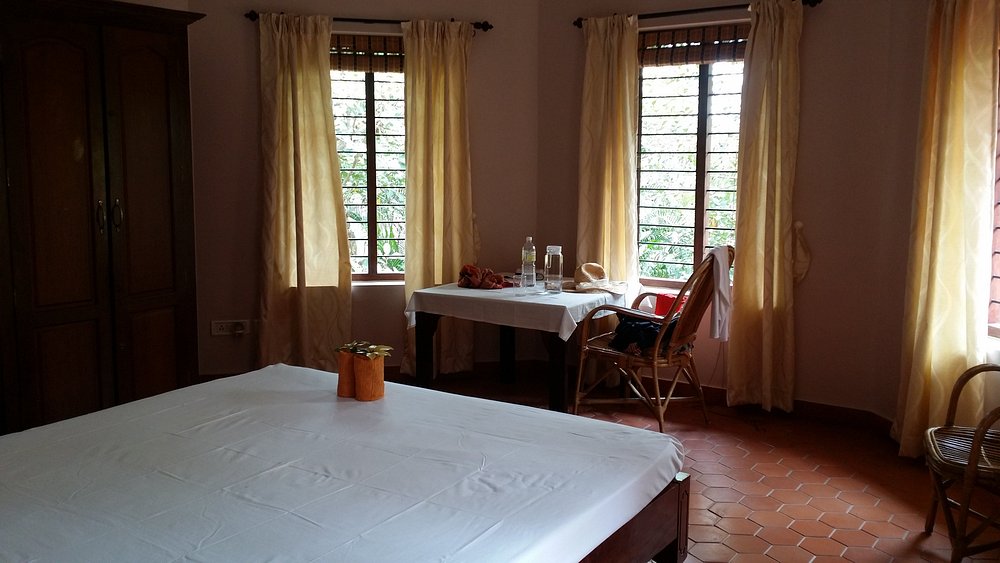
If something in you has been waiting a long time to soften, you are warmly welcome here. With only eight rooms and the lake nearby, Amrutham offers the kind of unhurried space in which the held can be released — gently, on your own terms, and in your own time.


