
There is a moment in many a yoga journey when the mat starts to feel too small — when the breath you have learned to follow begins to ask larger questions about how you live, eat, rest, and care for others. If that quiet pull has reached you, an ayurveda informed yoga teacher training may be the next, natural step inward. Not a rush toward certification, but a deepening — a return to the roots from which yoga and Ayurveda both grew.
Here in Kovalam, Kerala, where the sea air is soft and the days unhurried, we hold space for exactly this kind of turning. This is less about collecting a credential and more about becoming someone worth learning from — clearer, calmer, and more grounded.
Why an ayurveda informed yoga teacher training is different
Most teacher trainings treat yoga as a closed system of postures (asana), breath (pranayama), and philosophy. These are precious — but they are one half of a older, wiser conversation. Yoga and Ayurveda are sister sciences, born of the same vision of life as an integrated whole of body, breath, and mind. To teach yoga without Ayurveda is to read one page of a two-page letter.
An ayurveda informed yoga teacher training weaves the two back together. You learn not only what to teach but for whom — how a practice that steadies one student may unsettle another, and why. Ayurveda offers the language for that discernment: the idea of individual constitution (Prakriti), the play of the three biological energies or doshas, and the slow work of clearing toxins (ama) so that the body can rest in balance.
If you would like to understand the broader tradition before you begin, the overview of Ayurveda on Wikipedia offers an honest, well-sourced starting point.
What you will actually study
A training rooted in both traditions asks you to learn with your whole self — through study, practice, and lived experience on the property. While every cohort moves at its own rhythm, the foundations we return to include:
- Asana with intelligence: alignment, sequencing, and modification, taught so you understand the effect of each posture rather than merely its shape.
- Pranayama and meditation: breath as the bridge between body and mind, and the still attention that yoga ultimately serves.
- Ayurvedic foundations: constitution (Prakriti), the doshas, digestive fire (agni), and how daily and seasonal routines (dinacharya and ritucharya) support a steady practice.
- Philosophy and ethics: the yamas and niyamas, and the responsibility of holding space for another person's inner life.
- The craft of teaching: cueing, observation, sequencing for different bodies, and the quiet confidence that comes from genuine understanding.
You can see how this fits within our yoga offerings, where teacher training sits alongside gentler practice for those who simply wish to deepen their own sadhana (spiritual practice) without teaching.
Learning Ayurveda where it is still lived
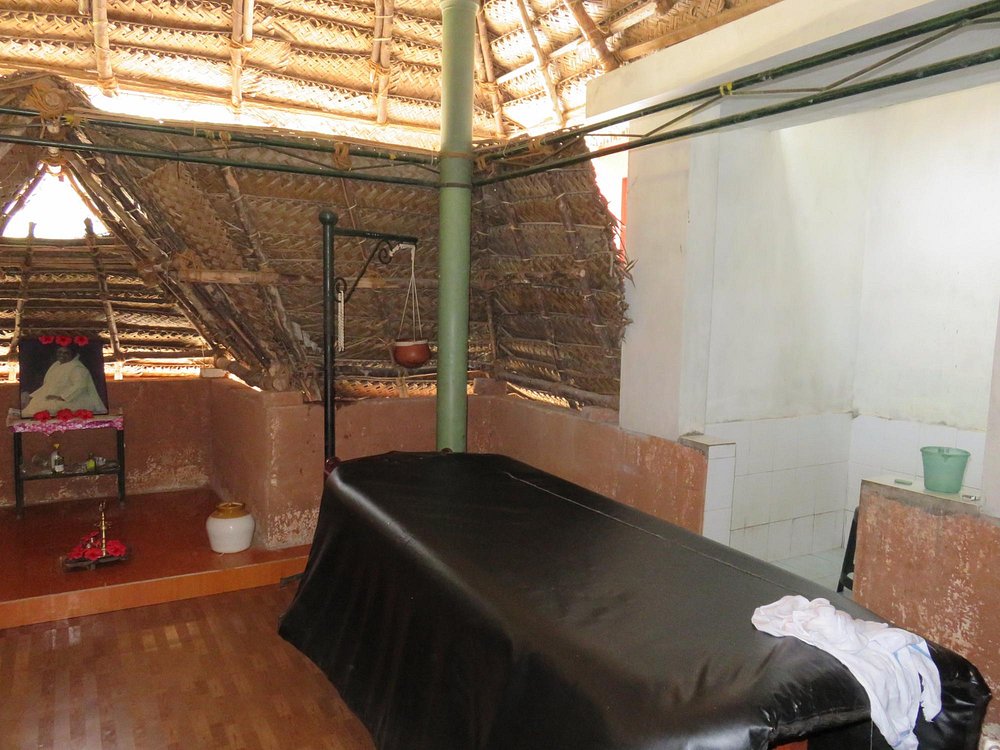
Kerala is widely regarded as the heartland of classical Ayurveda, where the tradition has been practised continuously for centuries and remains woven into ordinary life. To study an ayurveda informed yoga teacher training here is to learn the subject in its own home — among the herbs, the rhythms, and the cuisine that gave it meaning.
Our kitchen serves sattvic (pure, vegetarian) food prepared with care, so that what you eat supports rather than distracts from your practice. The mornings are quiet; the pace is deliberately unhurried. This is not a campus of hundreds but an intimate property of only eight rooms, near Vellayani Lake and roughly thirty minutes from Trivandrum airport — small enough that learning stays personal and unhurried.
There is a quiet difference between memorising Ayurvedic theory from a textbook and watching it shape a day. When the seasonal routine you have read about becomes the reason your morning practice feels lighter, the knowledge stops being abstract and starts to live in the body. Studying in Kerala lets the tradition teach you in this slower, more embodied way — through climate, food, and rhythm as much as through lecture.
Who an ayurveda informed yoga teacher training is for
You do not need to arrive as an advanced practitioner. What matters more is sincerity and a willingness to be changed by the work. This path tends to suit:
- Dedicated practitioners who feel ready to teach but want depth, not just a certificate.
- Existing teachers seeking to ground their cueing and sequencing in something older and more whole.
- Wellness professionals — therapists, bodyworkers, carers — who want a coherent framework for body and mind.
- Seekers drawn less to the title and more to the U-turn inward that serious study invites.
If you are not yet certain that teaching is your path, that is entirely welcome. Many begin with the Yoga package to taste the rhythm of daily practice here, then return for training when the time feels right. Our wider courses in Ayurvedic therapy can also complement the journey for those drawn to the healing arts.
A practice you can carry, and offer to others
What you take home from such a training is not a folder of sequences to be repeated. It is a way of seeing — the capacity to look at the person in front of you and meet them where they are. Yoga, understood through Ayurveda, traditionally aims not at performance but at balance: equanimity in the body, contentment in the mind, awareness underneath both.
This is also why an ayurveda informed yoga teacher training tends to change the teacher as much as the teaching. As you learn to read constitution and season in others, you begin to notice the same patterns in yourself — the foods that settle you, the practices that restore you, the small daily choices that keep you steady. A teacher who has done this inner work brings a different quality to the room: less performance, more presence; less instruction, more attention.
We make no extravagant promises. Real change is slow, and teaching well is a lifelong apprenticeship. What we can offer is a foundation laid with care, in a place that has held the practice for a very long time. To learn more about who we are and the philosophy that shapes us, you are warmly invited to read about Amrutham.
If something in you has been quietly preparing for this — the longer study, the deeper roots, the return to yourself — perhaps it is time to begin. We would be glad to walk a little of that road with you.


