
You have probably heard both words spoken as if they were the same thing, promised in the same breath by apps, teachers and glossy retreats. Yet the moment you sit down to actually practise, the question of meditation vs mindfulness stops being academic and becomes surprisingly personal. Are you meant to empty your mind, or simply notice it? Should you close your eyes, or stay wide awake to the tea cooling in your hands?
These are gentle questions, and they deserve honest answers rather than jargon. At Amrutham, tucked into the quiet green of Kovalam in Kerala, we watch guests arrive with exactly this confusion and slowly untangle it — not through theory, but through practice, breath and a little patience. Let us walk through the difference together, kindly and clearly.
Meditation vs mindfulness: two words, two intentions
The simplest way to hold the distinction is this: mindfulness is a quality of attention, while meditation is a deliberate practice you set time aside for. Mindfulness can happen anywhere — walking to the lake, tasting your food, feeling your feet meet the floor. It is awareness turned gently towards the present moment, without judgement. Meditation, by contrast, is when you sit (or lie, or move) with intention, training that same awareness in a more structured, sustained way.
Put another way, mindfulness is often what you are cultivating, and meditation is one of the main hows. You can be mindful without formally meditating, and you can meditate using techniques that are not, strictly speaking, mindfulness at all — mantra repetition, visualisation, or breath control (pranayama). The two overlap warmly, but they are not identical twins.
What mindfulness actually asks of you
Mindfulness is the art of noticing. It asks you to meet each moment as it is, rather than as you wish it were. Much of the modern understanding traces back to contemplative traditions and, later, to secular clinical programmes; you can read a broad overview in this encyclopaedic entry on the practice of mindfulness. In daily life it looks less like a special state and more like a soft returning:
- Sensory anchoring: feeling the warmth of a cup, the texture of rice, the sound of birdsong without narrating it.
- Non-judgement: letting a thought pass like weather rather than grading it good or bad.
- Gentle returning: noticing you have wandered, and coming back — a thousand times if needed, without scolding yourself.
Mindfulness is portable and undemanding of props. It may support calmer digestion of stress and a steadier mood, though it is a practice of relationship with the moment, not a promised remedy.
What meditation offers when you sit with it
Meditation is the wider umbrella, and mindfulness meditation is only one bloom beneath it. When you commit to a seated practice, you enter a tradition thousands of years deep — one that includes concentration on a single object, loving-kindness, breath awareness, and mantra. In the Indian lineage that shapes our approach, meditation is inseparable from a settled body and a quiet room; the outer stillness invites the inner.
A regular practice tends to reveal itself slowly. Rather than a dramatic switch, most people notice a widening of the gap between a feeling and their reaction to it — the beginning of equanimity. This is precisely where our A.C.E. framework lives: Awareness, Contentment, Equanimity, cultivated not as ideas to admire but as muscles to gently strengthen over days of practice.
Meditation vs mindfulness in everyday practice
If the theory of meditation vs mindfulness still feels slippery, everyday examples usually settle it. Consider a single ordinary morning:
- Mindful, not meditating: you drink your morning tea slowly, fully tasting it, aware of the steam and the quiet.
- Meditating, using mindfulness: you sit for twenty minutes and rest your attention on the breath, returning each time it drifts.
- Meditating, not mindfulness: you sit and silently repeat a mantra, or picture a candle flame, gathering the mind to a single point.
You do not have to choose one and abandon the other. In truth they nourish each other: formal meditation deepens the mindful quality you carry into the day, and everyday mindfulness makes your next sitting less of a struggle. For many of the guests who join our yoga and meditation offerings, the practices simply begin to blur into one continuous way of being present.
Where Ayurveda and Yoga meet the still mind
Here is something the meditation-versus-mindfulness debate often overlooks: the state of your body shapes the state of your mind. If your digestive fire (agni) is disturbed, if toxins (ama) have gathered, if sleep is thin, then sitting still can feel like wrestling. This is where Ayurveda quietly supports meditation — not as a cure, but as preparation. A therapy such as Shirodhara, the warm stream of oil poured over the brow, or a rhythmic oil massage (Abhyanga) can settle the nervous system so that stillness comes more naturally.
Yoga plays the same role from another direction, easing the body so it can be forgotten for a while. Understanding your own constitution (Prakriti) helps you choose practices that suit you rather than fight you. Woven together, this is our M·A·Y philosophy — Meditation, Ayurveda and Yoga as three threads of one cloth, each making the others possible. If a full immersion appeals, our contemplative retreats are built entirely around this weave.
Finding your own answer at Amrutham in Kovalam
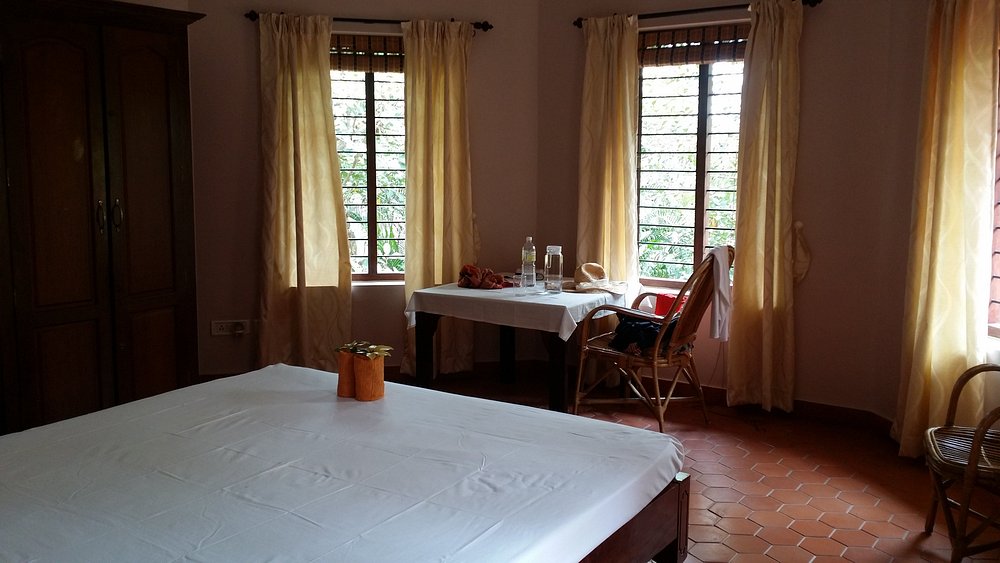
Some questions are answered not in a book but in a place quiet enough to hear yourself think. Amrutham is an intimate property of just 8 rooms, set near Vellayani Lake in Kovalam and roughly 30 minutes from Trivandrum international airport. It was never meant to be busy or commercial; it was meant to be still. Here the debate over meditation and mindfulness gently dissolves, because you are simply practising both, guided by qualified practitioners and nourished by sattvic vegetarian meals.
We think of a stay as a U-turn inward — a chance to stop performing wellness and start experiencing it. Whether you are drawn to the discipline of a seated practice or the soft attentiveness of a mindful walk by the water, you are welcome to arrive as you are. To understand the spirit behind the resort, you might wander through our story and philosophy before you come.
As with anything touching your health, do consult a qualified professional about your own circumstances. But if you feel ready to let the difference between meditation and mindfulness become lived rather than merely understood, there is a quiet room in Kovalam waiting for you.


