
There is a kind of healing that begins not with a pill or a procedure, but with a pair of skilled hands moving slowly along the body, reading its tensions, coaxing stuck places back into motion. For anyone recovering from a strain, a sprain, or the slow ache that lingers long after an injury has "healed", the idea of kalari uzhichal for injury recovery can feel like a quiet revelation — a practice that treats the body as a connected whole rather than a list of broken parts.
Here in Kovalam, near the still waters of Vellayani Lake, we hold space for this older, gentler way of mending. Kalari uzhichal — the therapeutic massage that grew out of Kerala's martial tradition — is one of the deepest roots of our work. If you are drawn to learn it properly, our Kalari Uzhichal Certification offers a grounded, hands-on path into the craft.
What kalari uzhichal is, and where it comes from
Kalari uzhichal is the body-conditioning massage of Kalaripayattu, the ancient martial art of Kerala. Warriors trained in the kalari (the practice arena) needed bodies that were supple, resilient, and quick to recover — so a sophisticated system of oil massage, joint work, and pressure-point therapy developed alongside the fighting forms. Over centuries this became a healing art in its own right, practised by the same masters (Gurukkal) who taught combat and set bones.
At its heart, the practice works with three ideas woven through Kerala's traditional medicine:
- Medicated oils: warm herbal oils chosen for the season and the person, used to soften tissue and carry herbs inward.
- Marma points: the vital points (Marma) where flesh, vessels, and joints meet, treated with precise, intelligent pressure.
- Rhythm and flow: long, continuous strokes — sometimes applied with the therapist's feet — that work the body as one connected field rather than isolated muscles.
How kalari uzhichal for injury recovery actually works on the body
When you think of kalari uzhichal for injury recovery, picture not a single forceful manipulation but a patient, layered approach to restoring movement. Old injuries often leave behind more than the original damage: guarding muscles, restricted joints, sluggish circulation, and a nervous system still braced for pain. Kalari work traditionally addresses each of these together.
In the classical understanding, the therapy may support recovery by:
- Easing stiffness: warm oil and sustained strokes can help relieve the tightness that settles into a joint after weeks of protecting it.
- Encouraging circulation: rhythmic massage is traditionally used to bring fresh blood and warmth to tissue that has grown cold and under-used.
- Releasing held tension: by working the marma points and the long lines of muscle, the practice can help the body let go of its defensive bracing.
- Restoring confidence in movement: as range returns gently, you begin to trust the limb again — often the slowest part of any recovery.
We are careful here to speak honestly. Kalari uzhichal is a traditional, hands-on therapy with a long lineage, not a substitute for medical care. A fracture must be set; an acute tear must be assessed; serious injury belongs first with a qualified doctor. What this work can offer is supportive, restorative care once the acute danger has passed — and it is most powerful when practised with knowledge, not improvised.
Why learn kalari uzhichal for injury recovery rather than only receive it
Many people first meet this therapy on a treatment table and leave wanting to understand what those hands were actually doing. To learn kalari uzhichal for injury recovery is to step behind the practice — to understand which strokes ease which patterns, how to read a body's history through touch, and where the marma points sit beneath the skin.
That deeper knowledge of the vital points connects naturally to Marma therapy, the precise pressure-point work that shares the same map of the body. Whether you are a yoga teacher, a bodyworker, a physiotherapist, or simply someone whose own recovery sparked a fascination, learning the craft turns a passive experience into a lasting skill you can carry — and offer — for years.
What you learn in the certification
Our certification is built to be practical and unhurried. You learn by doing, under guidance, with enough repetition that the movements settle into your hands rather than staying in your head. Broadly, the training covers:
- Foundations: the philosophy and lineage of kalari, and how its healing branch relates to Ayurveda.
- The strokes: hand and foot techniques, sequencing, pressure, and the all-important rhythm.
- Marma awareness: locating the vital points and understanding their care and caution.
- Oils and preparation: choosing and warming medicated oils, and preparing both the space and the receiver.
- Safety and limits: when massage supports recovery, and when to refer onward.
If you wish to widen your training, the certification sits comfortably alongside our other courses — including a broader Massage Course and the deeper Panchakarma certification for those wanting the full therapeutic picture of Kerala's healing tradition.
Learning in Kovalam, at an unhurried pace
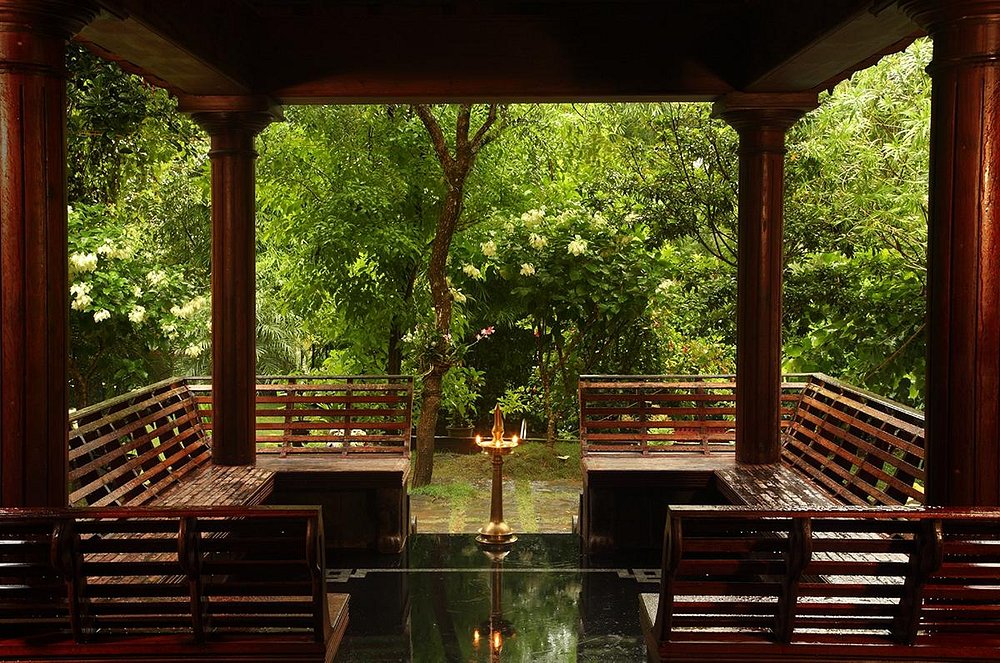
There is something fitting about learning this art in the place it grew — Kerala, where the smell of warm sesame oil and the slow rhythm of the strokes still belong to daily life. At Amrutham we are an intimate property of only eight rooms, which means your training is close, attentive, and personal. You are never one of a crowd.
Days unfold gently: practice, rest, sattvic (vegetarian) meals, and the quiet of a property held between garden and lake. The same stillness that makes a good place to recover makes a good place to learn — your attention has room to settle, and the work has time to sink in. This is, in our small way, a U-turn inward: a return not only to the body's wellbeing, but to your own steadiness.
If the idea of learning a centuries-old healing art — and carrying it forward with care — speaks to you, we would be glad to welcome you. Come and discover, with patient hands and an open heart, how kalari uzhichal supports the body's long, quiet work of mending.
Continue Exploring
- Kalari Uzhichal: Learning Kerala’s Warrior Bodywork
- Learn Kalari Uzhichal in Kerala: A Warrior's Healing Art
- Learn Panchakarma in Kerala: Tradition, Discipline and Daily Practice
- Learning to Sequence a Yoga Class: A Teacher's First Craft
- Panchakarma Certificate for Therapists: Responsibility After Training


