
There is a quiet moment, somewhere in the middle of a teacher training, when a question stops being academic and becomes personal: how do you actually hold a room of breathing, moving bodies and guide them well? For many trainees, the heart of that question lies in teaching hatha and vinyasa together — not as two rival styles to choose between, but as one continuous language of breath, posture, and attention.
We have watched this realisation arrive in our own trainees here in Kovalam — the slow understanding that a good teacher does not simply demonstrate shapes, but reads the room, slows the pace, and lets the breath lead. This is a craft. It can be learned, gently and well.
Hatha and vinyasa are closer than they look
It helps to begin with what these words actually mean. Hatha (often translated as the yoga of effort or force, ha and tha pointing to sun and moon) is the broad, classical family from which most modern postural practice descends. Vinyasa — a Sanskrit word that suggests a deliberate placing of things in sequence — links posture (asana) to breath (prana) so that movement and inhalation become one flowing thread. Seen this way, vinyasa is not separate from hatha at all; it is hatha set to the rhythm of breath. The wider tradition is described well in this overview of the history and principles of hatha yoga, which traces how a single contemplative lineage branched into the many styles taught today.
Understanding this shared root matters, because it changes how you teach. Instead of switching between two unrelated toolkits, you learn to move along a single spectrum — from stillness and long holds at one end, to fluid, breath-paced sequences at the other.
Why teaching hatha and vinyasa together makes you a steadier teacher
A trainee who can only flow, or who can only hold, is a teacher with half a vocabulary. When you are comfortable with both, you can meet the actual people in front of you — the stiff morning body, the restless mind, the tired traveller, the strong athlete who needs slowing down. The benefits of building both into your foundation include:
- Range: long hatha holds build awareness, alignment, and patience; vinyasa builds heat, rhythm, and breath capacity. Together they form a complete arc.
- Adaptability: you can soften a vigorous class for an injured student, or add gentle flow to wake a sluggish one, without abandoning your plan.
- Better cueing: holding a posture teaches you to describe it precisely; flowing teaches you to cue in time with breath. Each skill sharpens the other.
- Sustainability: a practice that only ever sprints burns students out. Pairing effort with stillness keeps the nervous system steady over years, not weeks.
The mechanics of teaching hatha and vinyasa together
So how does a class actually move between the two? In our experience, the bridge is almost always the breath. When you teach trainees to set the pace of movement to the length of an inhalation and exhalation, the transition from hatha to vinyasa stops feeling like a gear change and starts feeling like a tide. A few practical principles we return to again and again:
- Warm before you flow: open with grounded, slower hatha shapes so joints and attention are ready before the pace lifts.
- Let breath set tempo: one movement, one breath. If students cannot breathe smoothly, the sequence is moving too fast — slow it.
- Return to stillness: after a flowing peak, drop back into a held posture so the body can absorb what just happened.
- Plan peaks and rests: a well-shaped class rises and settles like a wave, rather than running flat-out from start to finish.
These are the very rhythms we explore in our Yoga Teacher Training, where sequencing is taught not as a fixed recipe but as a responsive, living skill.
What a grounded training gives you beyond the asana
A teacher is more than a choreographer of postures. The trainings that stay with people tend to weave in the wider context — anatomy taught with care, the ethical foundations of the practice, and the contemplative roots that give yoga its depth. At Amrutham, our philosophy is M·A·Y — Meditation, Ayurveda, and Yoga — held together by the A.C.E. framework of Awareness, Contentment, and Equanimity. That means a trainee does not only learn to teach a flow; they learn to teach from a place of stillness.
Because we are an Ayurvedic resort as well as a yoga school, our trainees also brush up against the deeper Indian wellness tradition — how constitution (Prakriti) shapes what kind of practice suits a person, and how digestive fire (agni) and balance inform how a body should move. You can read more about Amrutham and the philosophy that shapes everything we teach. For those who wish to keep practising rather than teach, the broader yoga offerings follow the same breath-led approach.
Learning where the practice is taught quietly
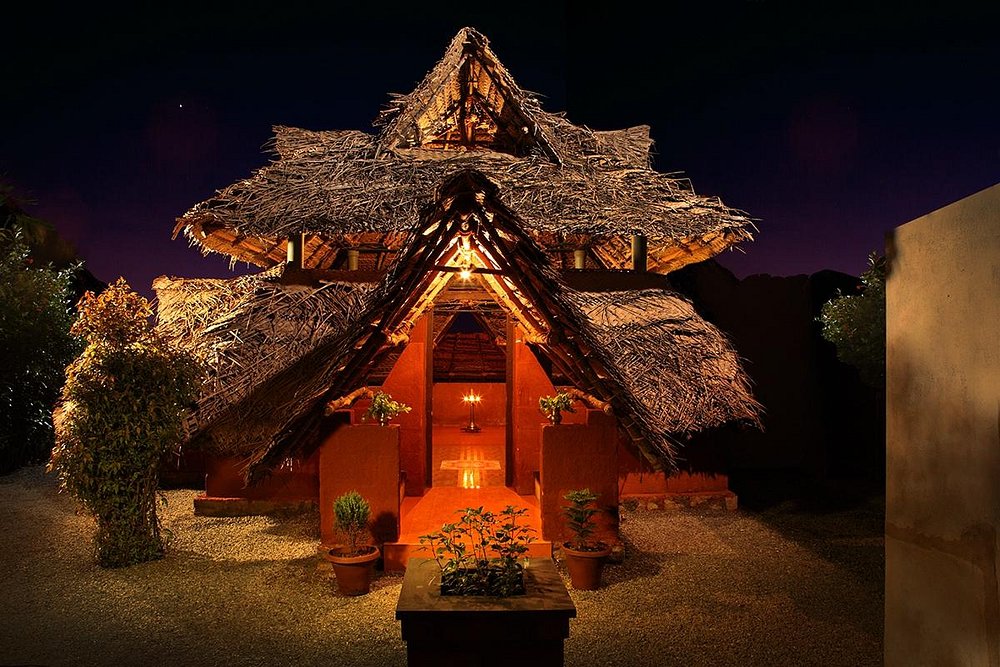
Kerala has carried yoga and Ayurveda gently across generations, and there is something clarifying about studying where the tradition still breathes in daily life rather than in a studio detached from its roots. Our home in Kovalam — an intimate eight-room property near Vellayani Lake, about thirty minutes from Trivandrum airport — was chosen for exactly this quietness. Away from noise and hurry, the long days of a training become a kind of U-turn inward, a return to yourself, where teaching hatha and vinyasa together is learned slowly enough to be learned for life.
Trainings such as ours sit alongside a wider family of classical courses, so you can shape the depth and direction of your study to suit where you are on the path.
A gentle word before you decide
Becoming a teacher is not a race, and it is not a transaction. It is a slow widening of attention — toward your own breath first, then toward the breath of the people who will one day trust you to guide them. If you feel ready to learn the craft of teaching hatha and vinyasa together, in a place that takes your wellbeing as seriously as your training, we would be glad to welcome you. As with any change to how you move and breathe, it is always wise to consult a qualified practitioner if you carry an injury or a health concern.
Come and learn where the air is soft, the pace is human, and the practice is honoured. The mat will be waiting.


