
There is a moment, in the warm hush of a treatment room, when skilled hands seem to read the body like a map — finding the knots, the held breath, the places where years have quietly settled in. If you have ever wondered what is kalari uzhichal massage, the simplest answer is this: it is the healing touch of Kerala’s ancient martial tradition, the same hands that once prepared warriors for battle now devoted to restoring ease, mobility, and calm.
It is a therapy born of movement and discipline, yet it asks something gentle of you — that you slow down, soften, and let yourself be cared for. For travellers and aspiring practitioners alike, learning this art is a way of meeting one of India’s living traditions at its source.
So, what is kalari uzhichal massage, really?
Kalari uzhichal is the therapeutic massage developed within Kalaripayattu, the centuries-old martial art of Kerala. The word kalari refers to the training ground where warriors learned to move; uzhichal means the act of massage or anointing. Together, they describe a treatment that grew up alongside combat — a way of keeping the warrior’s body supple, swift, and free of injury, and of healing it when injury came.
What sets it apart is its intimacy with the body’s vital points (marma) — the junctions of muscle, nerve, ligament, and bone where life-energy (prana) is understood to concentrate. The masseur works the whole body with warm medicated oil, often using not only the hands but the feet, applying rhythmic, pressing strokes along the channels through which energy and movement flow. It is at once invigorating and deeply settling — a paradox you only understand once you have felt it.
Where a conventional massage may aim chiefly to relax, kalari uzhichal carries the intent of the warrior’s body — to restore range of motion, to realign, and to ready the body for movement. The strokes follow the grain of the muscles and the lines of the marma points rather than wandering at random, and the medicated oil is chosen with the same care a physician would bring. It is a structured, knowing kind of touch, and that intelligence is exactly what makes it worth learning slowly.
The roots: where this tradition comes from
Kerala has carried this knowledge for generations, passing it from teacher (gurukkal) to student in the kalari itself. The massage was never separate from the martial art — it was its quieter half. A fighter trained hard, and the same lineage that taught the strikes also taught how to mend the body afterward, how to align it, and how to keep it limber into old age.
This is part of the wider heritage of healing for which the region is known, sitting alongside classical Ayurveda and the wider world of Marma therapy. To learn kalari uzhichal is to step into a stream of practice that has flowed, largely unbroken, for a very long time — and to receive it with the care that tradition deserves.
What is kalari uzhichal massage believed to support?
Traditionally, this therapy has been used to keep the musculoskeletal system mobile and the mind quiet. We make no exaggerated promises, and we’d always encourage you to consult a qualified practitioner for any specific condition — but here is what the tradition holds it may support:
- Flexibility and mobility: the long, oiled strokes are traditionally used to ease stiff joints and lengthen tight muscles.
- Circulation: rhythmic pressure can help warmth and blood move into tired, neglected tissue.
- Relief from tension: by working the vital points, the treatment can help relieve the deep, holding tension that desk-bound lives quietly accumulate.
- Recovery and resilience: athletes and dancers have long turned to it to recover after exertion and to guard against strain.
- A settled mind: like much of Kerala’s touch-based work, it tends to leave you clearer, calmer, and more grounded.
Learning the art: the Kalari Uzhichal Certification
Receiving a massage is one thing; learning to give one is another journey entirely. Our Kalari Uzhichal Certification is for those who feel called to carry this tradition in their own hands — bodyworkers, yoga teachers, Ayurveda enthusiasts, and curious travellers who want more than a passing taste.
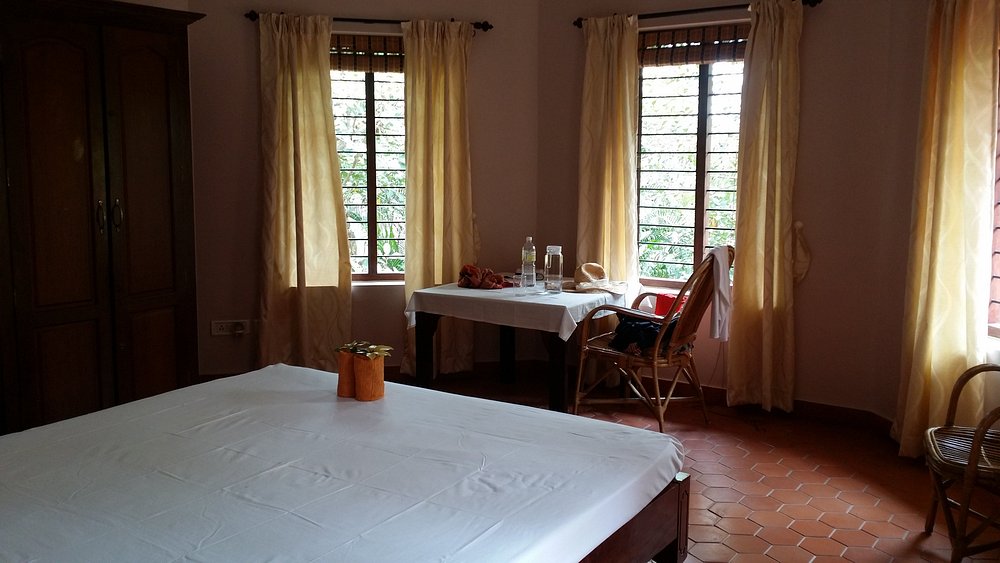
You learn under qualified practitioners, in the unhurried rhythm of an intimate property of only eight rooms. There is time to absorb, to ask, to practise. You come to understand the body’s vital points not as theory but as something your hands begin to recognise — the anatomy beneath the skin, the sequence of the strokes, the right pressure and warmth of the medicated oil. It is steady, attentive work, and it changes how you understand touch itself.
If your interest reaches more widely into Kerala’s healing traditions, you might also explore our courses as a whole, where the Massage Course and the Panchakarma certification open complementary doors into the same lineage of care.
What a session actually feels like
If you are new to it, here is what to expect when you receive — or learn to give — kalari uzhichal:
- Warm oil first: the body is generously anointed with medicated oil, chosen to suit your constitution (Prakriti) and the season.
- Long, flowing strokes: the practitioner works rhythmically along the limbs and torso, sometimes using the feet for broad, even pressure.
- Attention to vital points: focused work on the marma points, where the tradition locates concentrated energy.
- Stillness afterward: rest matters as much as the massage; the body is given time to absorb the oil and the calm.
A gentle word of care
Like all bodywork, kalari uzhichal is most beneficial when it meets you where you are. If you are pregnant, recovering from injury or surgery, or living with a chronic condition, please speak with a qualified practitioner before booking a session — the treatment can be adapted, but it should be approached with honesty about your body and its needs. This is touch in service of health, never a substitute for medical care.
At Amrutham, our home in Kovalam near Vellayani Lake, we hold these traditions with patience and respect. To learn the healing touch of Kerala here is to take a quiet U-turn inward — to slow down, to study with care, and to leave carrying something real in your hands. If the question what is kalari uzhichal massage has begun to feel like an invitation, we would be glad to welcome you to learn it where it has always lived.


