
Before a therapist's warm palms ever glide along your spine with medicated oil, there was a warrior learning to fall, to breathe, to move like water and strike like lightning. To understand kalari massage honestly, you have to walk back into the history of kalaripayattu — the ancient martial art of Kerala from which those healing hands were born. It is a story of discipline and devotion, of soldiers who were also healers, and of a body-wisdom that Kerala has quietly kept alive for centuries.
Here at Amrutham, tucked into the green quiet near Kovalam, we love this lineage because it holds a truth we return to daily: the body is not a machine to be fixed but a landscape to be understood. Let us trace where it all began.
The ancient history of kalaripayattu: roots in Kerala's soil
Kalaripayattu takes its name from the kalari — the sacred earthen training pit, usually dug below ground level and aligned to the cardinal directions — and payattu, meaning practice or combat. Widely regarded as one of the oldest surviving martial traditions in the world, it grew out of the martial cultures of ancient Kerala, shaped over generations by warrior clans, temple guardians and village defenders. You can read a broad account of its development in this overview of the martial art Kalaripayattu.
Practice traditionally moved through four stages, each building on the last:
- Meithari: body-conditioning through flowing sequences, kicks, jumps and balance — the foundation.
- Kolthari: training with wooden weapons such as the staff and the curved otta.
- Ankathari: metal weapons, including the sword, shield and the flexible urumi.
- Verumkai: bare-handed combat, the art of the empty hand.
Every stage began and ended with reverence — a bow to the ground, the guru (Gurukkal) and the deity of the kalari. This was never violence for its own sake. It was a way of forming a whole person.
From battlefield to bodywork: how the warrior became a healer
A warrior who could break a body also had to know how to mend one. So the master of the kalari was traditionally a healer too, versed in marma — the vital points where breath, blood and life-force (prana) are said to gather. The same knowledge that let a fighter disable an opponent allowed a Gurukkal to release a stiff joint, ease an old injury or restore mobility to a tired body.
From this dual mastery came Kalari Uzhichil — the martial-medicinal massage. Delivered with medicated oils, sometimes with the practitioner's feet using ropes for balance and controlled pressure, it was originally used to keep warriors supple, quick and resilient. Over time it flowed naturally into the broader stream of Ayurveda (the traditional science of life), and its close cousin, focused work on the vital points, matured into what we now offer as authentic Marma therapy. If the deeper training itself calls to you, there is even a structured path through a Kalari Uzhichal certification course.
What kalari massage may support today
Stripped of the battlefield, the same bodywork now serves a gentler purpose. Practised by qualified hands, kalari-influenced massage and marma work are traditionally used to:
- Encourage flexibility and ease of movement in stiff joints and muscles.
- Help relieve the deep tension we carry in the back, neck and shoulders.
- Support recovery for those who move a lot — athletes, dancers, travellers.
- Invite a settled, grounded feeling that many describe as coming home to the body.
A responsible word, though: this is a tradition, not a promise. Kalari massage may support wellbeing and comfort, but it does not replace medical care. If you carry an injury, a chronic condition or any health concern, please speak with a qualified doctor first, and let your therapist know. Real Ayurveda begins with an honest consultation, never a one-size-fits-all treatment. You can explore how such classical bodywork is offered within our specialised therapies.
Why this lineage still matters for the modern traveller
We live fast and think faster. The history of kalaripayattu offers a quiet corrective — a reminder that strength and softness are not opposites, that the body learns through patience, and that healing is a discipline as much as a gift. When you receive kalari-rooted bodywork, you are not simply buying an hour of relaxation. You are stepping into a river that has flowed through Kerala for a very long time.
That is why we frame every stay not as a treatment list but as a slow, honest return to yourself. Ayurveda invites you to understand your own constitution (Prakriti), to tend your digestive fire (agni), and to let the nervous system unclench. Kalari heritage adds its own note: move well, breathe well, and let the hands that once trained warriors now teach you to soften.
Where the history of kalaripayattu meets Amrutham in Kovalam
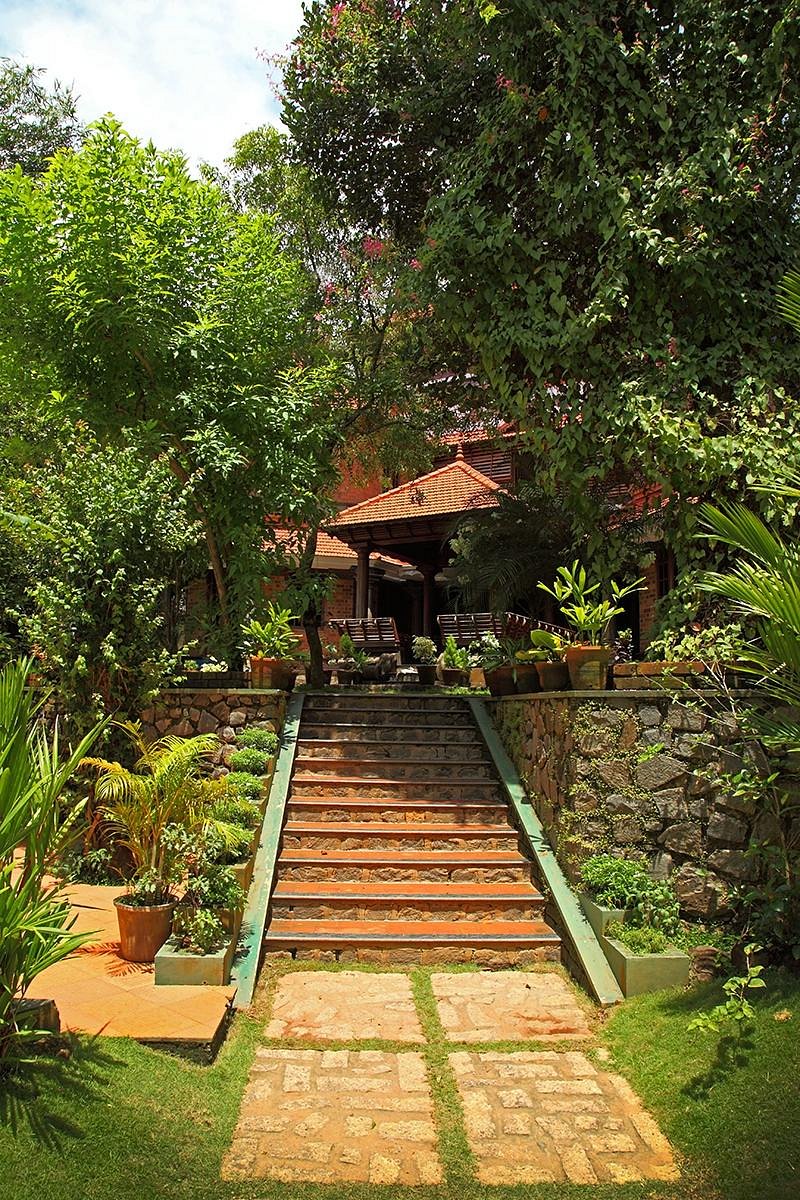
Amrutham is an intimate place — only 8 rooms — set near Vellayani Lake in Kovalam, about 30 minutes from Trivandrum (Thiruvananthapuram) international airport. We are deliberately small and deliberately quiet, so that the old rhythms of Kerala can actually be felt rather than merely watched.
Our philosophy is M·A·Y — Meditation, Ayurveda and Yoga — held together by a simple framework we call A.C.E.: Awareness, Contentment, Equanimity. A stay here is what we fondly call a "U-turn inward". Days move gently: sattvic (vegetarian) meals, unhurried therapies with qualified practitioners, morning yoga, and long evenings beside the water. The warrior's discipline becomes, in this setting, an invitation to stillness. If a deeper Ayurvedic reset appeals, our Ayurveda retreat programmes weave these threads together over a longer stay.
Begin your own quiet chapter
The history of kalaripayattu reminds us that the hands offering you oil today once belonged to a lineage of warrior-healers who understood the body from the inside out. To receive that inheritance well, you need only slow down, breathe, and be present. That is the whole invitation of Amrutham — no urgency, no spectacle, simply Kerala's living tradition, offered with care beside a quiet lake in Kovalam. Whenever you are ready, we would be glad to welcome you.


