
You can learn the names of the therapies from a book. You can memorise the doshas, recite the five actions, even watch a hundred videos of warm oil falling in a steady thread. And yet, if you have ever felt the pull to truly understand Panchakarma — not as information, but as a living craft passed from hand to hand — some quiet part of you already knows that real Panchakarma training cannot be reached through a screen.
For aspiring practitioners and serious students, the question is rarely whether to study Panchakarma. It is where. And the honest answer keeps leading back to Kerala — the southern Indian state where this tradition never became history, because it never stopped being practised. Here is why Panchakarma training at the source is different, and why it matters.
A tradition that stayed alive
Panchakarma — Sanskrit for the “five actions” — is the classical cleansing and rejuvenation tradition at the heart of Ayurveda, the centuries-old Indian science of life. In much of the world it survives as theory, reconstructed from texts and adapted to whatever oils and conditions are at hand. In Kerala, it was never reconstructed, because it was never lost.
The reasons are partly geographic. Kerala’s humid, monsoon-soaked climate keeps the body’s channels open and receptive to oil therapies, so the region leaned into Snehana (oleation) and Swedana (herbal steam) in ways drier places never could. Generations of physician families — many tracing their lineage through the Ashtavaidya tradition — kept the methods refined and unbroken, teacher to student, parent to child. When you study here, you are not learning a revival. You are stepping into a current that has been flowing, without interruption, for a very long time.
The knowledge that lives in the hands
So much of Panchakarma cannot be written down. It is not that the texts are incomplete — they are extraordinary — but that the decisive knowledge is felt, not stated. How warm should the oil be against this particular skin, today? How much pressure does this body want during Abhyanga (the warm herbal-oil massage), and where does it quietly resist? When does the pulse say the patient is ready for the main actions, and when does it ask for one more day of preparation?
These are judgements built from repetition under a watchful eye — the kind of tacit, hand-held learning that no manual can hold. Good Panchakarma training at the source means absorbing the small things that separate competent technique from genuine care:
- Touch and timing: the feel of correct temperature, rhythm and pressure, learned by doing rather than describing.
- Reading the individual: how a seasoned practitioner adjusts a protocol to a real person’s constitution (Prakriti), age and state — not a textbook average.
- Preparation as the real work: why the patient days of Purvakarma (preparation) and Paschatkarma (renewal) matter more than the dramatic middle, and how to pace them.
- Knowing when to wait: recognising who is not yet ready, and having the discipline to say so.
Clinical exposure no Panchakarma training can simulate
There is a difference between a course that teaches about Panchakarma and one that lets you stand beside it as it happens. Real learning needs real patients — people arriving with sluggish digestion, depletion, long-held tension, the ordinary heaviness of modern life — and the chance to observe how an experienced practitioner meets each of them differently.
In Kerala, that exposure is not staged for students; it is the daily reality of places that treat guests year-round. You watch a consultation and pulse reading. You see the medicated ghee and herbal decoctions prepared. You learn why Vamana (therapeutic emesis) suits one constitution and Virechana (purgation) another, or why Basti (medicated enema) is so valued for settling Vata — and you see those choices made for an actual human being, with all the nuance that demands. This is the texture our range of Ayurveda and Panchakarma courses is built around: learning with your eyes, hands and attention, not only your notebook.
Authentic oils, herbs and methods
A great deal of Panchakarma’s power rests on its materials — and materials are exactly what get diluted when the tradition travels. The medicated oils and ghees at the centre of the practice are not generic carriers; they are made by simmering specific herbs into a base over hours, sometimes days, following classical formulae. Many of those herbs grow in Kerala’s own soil. The freshness, the sourcing, the preparation by people who have made them a thousand times — these are not details. They are the medicine.
When you learn at the source, you learn the methods and the means together: how a particular oil is chosen and warmed, how a decoction is judged ready, how Shirodhara — the soothing stream of warm oil poured over the forehead — is set up so the temperature and flow stay steady throughout. Studying the technique without the authentic substance is like learning to cook from a recipe you can never taste. Here, you taste it.
Learning inside a working retreat
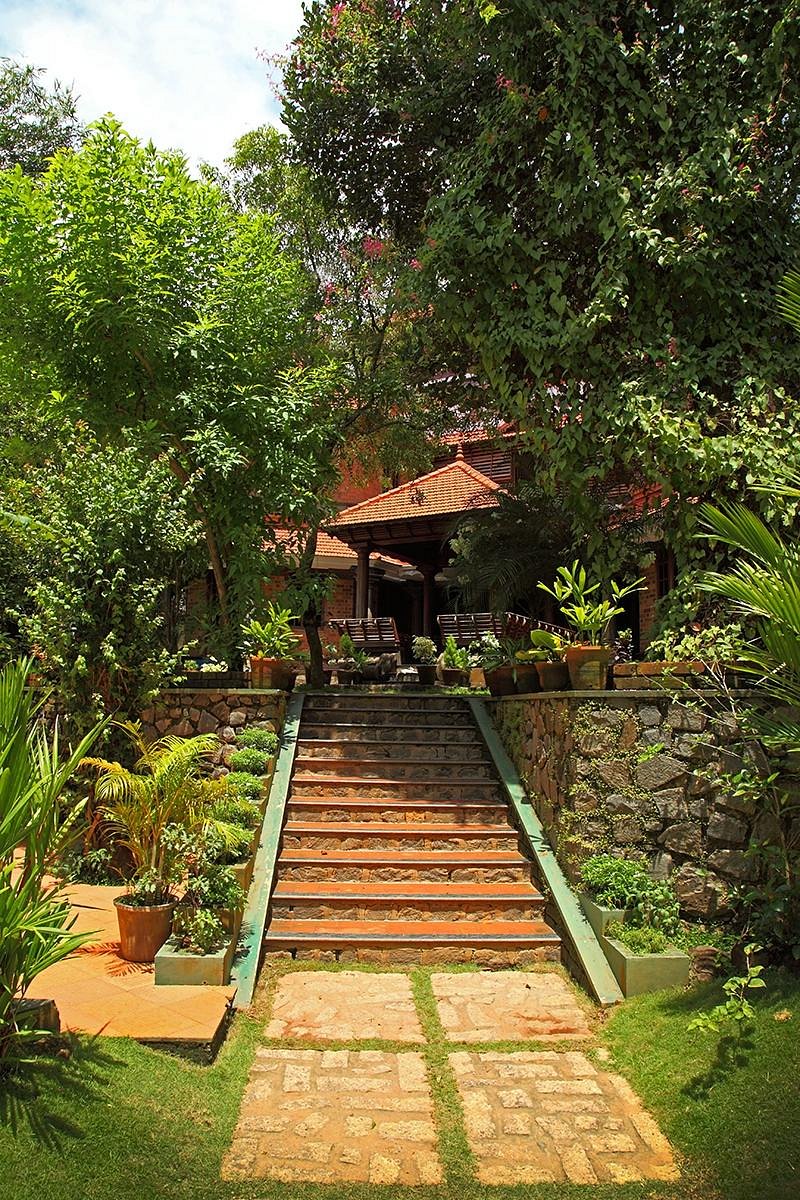
There is a particular kind of education that only happens where the teaching and the healing share one roof. Studying within a small, working retreat — rather than a lecture hall removed from any patient — changes what you absorb. You see the whole arc, not a fragment: how the day is paced, how rest and sattvic (vegetarian) food and gentle yoga hold the clinical work, how the calm of the place is itself part of the treatment.
It also tends to be intimate. In a quiet, nature-immersed setting you are not one of a hundred; you are close enough to the work to ask the question that matters and actually be answered. And because the same therapies you are studying are offered to guests as living programmes — a classical Panchakarma, or a gentler Detox programme for those easing into the tradition — you witness the full spectrum of how the methods are matched to real needs. You learn the craft and the care at once, which is the only way either is truly learned.
Studying responsibly — and for the long term
A word of honesty, because this work deserves it. Panchakarma is powerful and deeply individual, and it carries real responsibility: certain therapies are contraindicated in pregnancy, acute illness or frailty, and a good practitioner is defined as much by restraint as by skill. Serious study should make you more careful, not less — clearer about scope, humbler about claims, and committed to working alongside conventional medicine rather than against it.
Approach it that way and the rewards are quietly enormous. To learn at the source is to inherit not just a set of procedures but a way of seeing — patient, attentive, and grounded in something older than any of us. It is the difference between performing Panchakarma and understanding it.
A place to begin your Panchakarma training
At Amrutham, an intimate eight-room retreat in Kovalam, Kerala — near the still waters of Vellayani Lake, about thirty minutes from Trivandrum airport — Panchakarma is practised the unhurried, classical way, by qualified practitioners, within a working retreat held in deliberate quiet. We frame everything here through the principles we call M·A·Y — Meditation, Ayurveda, and Yoga — and that same care shapes how we teach.
If the pull you feel is towards understanding this tradition from the inside — to learn it where it has always lived, with real patients, authentic oils and unbroken methods — then Panchakarma training at the source is not a luxury. It is the whole point. Our 21-Day Panchakarma Certification Course is built for exactly that: serious, hands-on study of a living craft, in the place it was never allowed to fade.
Continue Exploring
- Why Train as a Yoga Teacher in India, the Birthplace of Yoga
- Yoga Alliance, RYT and RYS: What the Certifications Actually Mean
- Yoga Teacher Salary in India: An Honest Guide for New Teachers
- Yoga Teacher Training Accommodation and Meals: What to Expect
- Inside a YTTC Curriculum: Asana, Anatomy, Philosophy and Teaching


