
Some callings announce themselves quietly. You notice it when a tired friend rests their head on your shoulder and something in you knows exactly where to press; when the idea of spending your days easing another body's burden feels less like work than like coming home. If a healing vocation has been tapping at your shoulder, training as an Ayurvedic massage therapist is one of the most grounded, human ways to answer it.
This is not the kind of skill you absorb from a video. It lives in the hands — in pressure and rhythm, in oil and breath, in the slow conversation between a therapist's palms and another person's tissues. It is taught, as it always has been, by watching, doing, and being corrected; and there are few better places to begin than Kerala, the green coastal cradle where this tradition has been kept alive, unbroken, for centuries.
What Ayurvedic bodywork really is
Ayurvedic massage is not the same as the relaxation massage you might know from a spa. At its heart sits Abhyanga — warm-oil massage applied along the body in deliberate directions, working with the channels through which Ayurveda understands energy and nourishment to flow. The oil is not an afterthought but a medicine in itself: warmed, often herb-infused, and chosen to suit the person on the table. The strokes are meant to soften dryness, loosen the joints, settle an over-active nervous system, and help the body release what it has been holding.
Underneath the technique runs a quietly sophisticated map of the body. A good Ayurvedic massage therapist learns to read a person's constitution (Prakriti) — the balance of the three doshas, the functional energies of body and mind — and to adjust touch accordingly: lighter and warmer for an airy, easily-depleted Vata; cooler for a fiery Pitta; firmer and more rousing for a heavy, slow Kapha. Layered onto this is an understanding of the marma points — the vital junctions where flesh, vessel, bone, and breath meet, treated with particular care. To learn Ayurvedic bodywork well is to learn to listen with your hands.
What Ayurvedic massage therapist training actually involves
Real training is overwhelmingly practical. You will spend far more time with oil on your hands than with a book open, because this craft is built in the body and refined under a teacher's eye. A grounded course tends to move through clear stages — foundations first, then full sequences, then supervised practice until the work becomes steady and your own. Along the way, you can expect to learn:
- Full-body sequences: how to move with intention across head, neck, shoulders, arms, hands, back, abdomen, legs, and feet — as one flowing treatment rather than a series of parts.
- Oil, pressure, and rhythm: warming and applying medicated oils, and the subtle control of pressure, direction, and pace that separates a forgettable massage from a healing one.
- The therapist's own body: posture, breath, and body mechanics, so that you can work for years without injuring yourself — a skill new practitioners almost always underestimate.
- Foundations of anatomy and Ayurveda: muscles, joints, and circulation alongside the basics of dosha, constitution, and the marma points, so your hands are guided by understanding.
- Care and professionalism: hygiene, draping, client assessment, consent, and communication — the quiet ethics that make a therapist trustworthy.
Our own Ayurvedic massage course is built in just this spirit — practical first, residential, and small enough that your hands are watched and guided rather than lost in a crowd. It welcomes complete beginners as warmly as it does spa therapists and yoga practitioners looking to deepen their touch, and it closes with a practical assessment and viva before certification, so that what you carry away is genuinely earned.
The sensitivity it builds in you
People come for the technique and leave changed by something subtler. Learning to give an Ayurvedic massage trains a kind of attention most of us are never taught: the patience to slow down, the steadiness to stay present with another's discomfort without rushing to fix it, and a tactile intelligence that lets your hands notice what the mind would miss — a held breath, a guarded shoulder, the moment a body finally lets go.
It is, in the truest sense, a practice of service — and touch carries the state of the one who gives it. That is why this kind of training so often becomes personal as well as professional: you cannot spend your days helping others unwind without learning, a little, to unwind yourself.
Where the Ayurvedic massage therapist path can lead
A foundation in Ayurvedic bodywork opens more doors than people expect. Where it leads depends on what drew you to it in the first place:
- A livelihood in wellness: the skills travel. Trained, confident hands are sought after in wellness centres, spas, Ayurveda resorts, and retreats across the world.
- A deeper layer to existing work: yoga teachers, physiotherapists, and bodyworkers often fold Ayurvedic touch into what they already offer, enriching it.
- A doorway to further study: many find this is only the beginning, and go on toward Panchakarma therapy, marma work, or related traditions.
- A gift for those you love: not everyone trains to earn. Some simply want the lifelong ability to ease a partner's back, a parent's stiffness, or their own tired body.
If your curiosity runs wider than massage alone, it is worth seeing the full range of Ayurveda and wellness courses we hold here, so you can find the path that fits your calling rather than forcing your calling to fit a path.
A related path: Kalari Uzhichal
Kerala's bodywork is not one tradition but several, woven together over centuries. Alongside classical Ayurvedic massage runs a more vigorous cousin born on the training grounds of the warriors: Kalari Uzhichal, the therapeutic oil massage that grew out of Kalaripayattu, the region's ancient martial art. Developed first to keep fighters supple and quick to heal, it works deeply with the marma points and the body's lines of movement, and is treasured today for flexibility, mobility, and recovery.
For many therapists the two are beautifully complementary — the nourishing stillness of Abhyanga and the dynamic, releasing power of the martial tradition. If that stronger current calls to you, our Kalari Uzhichal certification teaches its strokes, sequences, and marma work in the same hands-on, residential way, rooted in the very soil where it was born.
Why becoming an Ayurvedic massage therapist in Kerala matters
You can study Ayurvedic massage in many places now, but Kerala is where the living thread has never been cut. This is the land where Ayurveda was sheltered and practised continuously while it faded elsewhere; where the monsoon, the herbs, the oils, and the unhurried rhythm of life all shaped the medicine into what it is. To train as an Ayurvedic massage therapist here is to learn in context — to feel the climate the therapies were designed for, to use oils made the traditional way, and to receive the craft from teachers who carry it as inheritance rather than information.
There is also something to be said for where you stand while you learn. A skill of touch and presence is best absorbed somewhere itself calm and attentive — not a busy classroom, but a place quiet enough to let the work sink in.
Beginning, at Amrutham
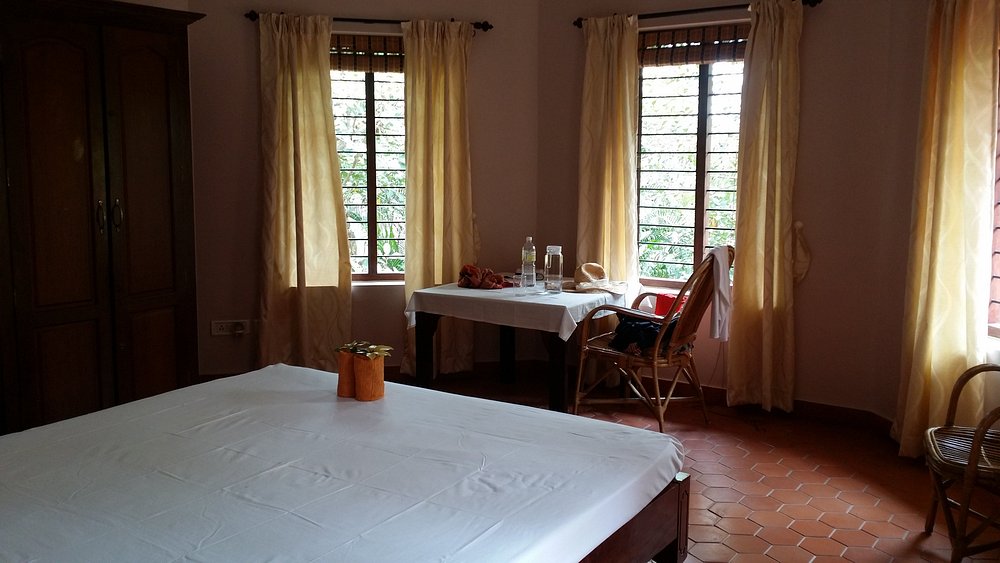
That is the setting we try to offer. Amrutham is a small resort — only eight rooms — in Kovalam, Kerala, set in quiet nature near Vellayani Lake, about half an hour from Trivandrum international airport. Days here move to the rhythm we hold to, M·A·Y — Meditation, Ayurveda, and Yoga — and to a simple framework we call A.C.E.: Awareness, Contentment, Equanimity. For someone learning to heal with their hands, that unhurried, nature-immersed stillness is not a backdrop but part of the teaching.
A vocation in healing rarely arrives as a thunderclap. More often it begins as a quiet pull — toward usefulness, toward presence, toward work that means something. If becoming an Ayurvedic massage therapist is the shape that pull has taken for you, we would be glad to help you take the first, grounded step.


