
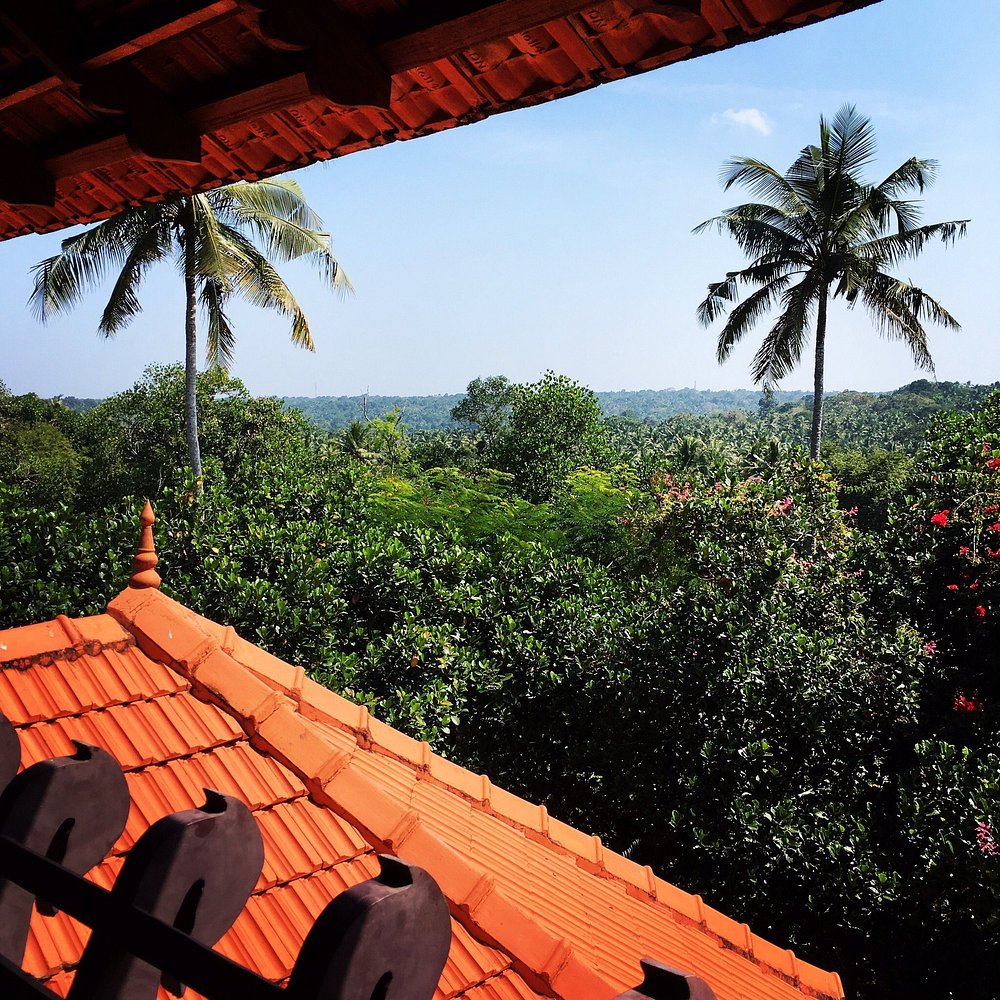
Most people who arrive for a yoga teacher training in Kerala imagine they are coming to learn how to teach. They leave having learnt something larger and less expected — how to practise, how to pay attention, and how to live a little closer to the ground. The certificate at the end is real and useful, but it is rarely the part anyone remembers most. What stays with you is the version of yourself the weeks slowly uncover.
To undertake a yoga teacher training in Kerala is to do it where so much of this tradition was kept alive — the long green coast of South India where Ayurveda and yoga grew up as sister sciences, one tending the body, the other the mind and breath. A residential training here is not a course you attend and then drive home from. It is an immersion: weeks of living inside the practice, in a place built for turning inward. Here is what that experience tends to ask of you, and what it gives back.
A day shaped by practice, not by a clock
The first thing a residential training rearranges is your sense of time. The day no longer belongs to your inbox; it belongs to the practice. You rise early, while the air is still cool and the lake is quiet, and the morning opens — not with a screen, but with breath and movement. Schools keep different rhythms, so rather than promise a fixed timetable, it is more honest to describe the shape most days take:
- An early start: the calm hours after dawn — traditionally considered the most sattvic, or clear and balanced, part of the day — are when the mind is most willing to sit and the body most willing to move.
- Two practice sessions: typically a fuller, more dynamic practice in the morning and a slower, restorative one later, so the body is both built and unwound across the day.
- Study in the gentler hours: philosophy, anatomy, and the craft of teaching tend to fall in the middle of the day, when the body rests and the mind is alert.
- Unhurried, nourishing meals: sattvic, vegetarian food eaten slowly, which itself becomes part of the practice rather than an interruption to it.
Lived for several weeks, this rhythm does something a weekend workshop never can. Repetition stops being routine and becomes refuge. The early mornings that felt severe in week one become, by the end, the hours you would not surrender.
More than postures: the four threads of the training
A common surprise is how little of a serious teacher training is spent perfecting shapes. The physical postures (asana) are the visible part, but a genuine course weaves several strands together, because a teacher needs all of them. Broadly, the work moves along four threads:
- Practice (asana and Pranayama): refining your own postures and breathwork — Pranayama is the regulation of the breath — not as performance but as a foundation you can teach from honestly.
- Philosophy: the roots beneath the poses — the Yoga Sutras of Patanjali, the eight limbs (Ashtanga) that frame yoga as a whole way of living, and the ethical ground (the Yamas and Niyamas) beneath it.
- Anatomy and physiology: how the body actually moves, where it is vulnerable, and how to keep a student safe — both the modern anatomy of muscle and joint, and the subtle anatomy of energy (prana) and its centres (chakras).
- Teaching practice: the real craft — sequencing a class, cueing with clear words, observing bodies that are not your own, and offering adjustments with care.
It is the teaching practice that tends to undo people in the gentlest way. Standing before your peers and guiding them through even a few postures is humbling, and it is where philosophy and anatomy stop being theory and become something you can hold in your hands. You begin to understand that to teach is, first, to see.
Why a Yoga Teacher Training in Kerala, and Why Immersion Matters
You can learn the mechanics of teaching almost anywhere. What you cannot easily replicate is context — and a yoga teacher training in Kerala offers that in abundance. Here, yoga has never been separated from the wider science of living it grew alongside: Ayurveda is woven into daily life, the food is naturally sattvic, and the unhurried pace of the coast quietly supports the inward turn the practice asks for.
Immersion is the heart of it. When you live where you study — waking, practising, eating, and resting in the same calm place — the boundary between learning yoga and living it dissolves. There is no commute to break the thread, no return each evening to the noise you came to escape. The practice seeps into the hours between sessions, which is where it does its deepest work — and that changes what the training is able to reach.
The transformation beyond the certificate
If you ask graduates what they took away, few begin with the qualification. They speak instead of subtler changes — a steadier mind, a quieter relationship with their own thoughts, a body they finally listen to. Spending weeks inside a disciplined practice, away from your usual distractions, tends to surface things: old habits become visible, and patience grows where it was thin.
This is the part no syllabus can guarantee and no honest school will oversell. A teacher training is not therapy, and it does not promise to fix anything. But the conditions it creates — early rising, sustained attention, simple food, real community, and time away from the phone — are unusually fertile ground for change. Whether or not you ever teach a class, you tend to leave with a practice that is genuinely your own, and a calmer, clearer, more grounded way of meeting your days.
Choosing a Yoga Teacher Training in Kerala: Questions Worth Asking
Not every course is the same, and the immersive ones are demanding by design. It is worth choosing with clear eyes rather than being swept along by photographs. A few questions tend to matter more than glossy promises:
- Who is teaching, and how small is the group? Intimate cohorts mean you are seen, corrected, and supported as an individual.
- Is it residential, and what is the setting like? The place you live during the weeks shapes the experience as much as the curriculum does.
- Does it honour the whole tradition? A complete training holds philosophy, anatomy, and ethics alongside the postures — not asana in isolation.
- Are you ready for the rhythm? Early mornings and long days reward you, but it helps to arrive prepared to be stretched, not pampered.
If you are weighing your options, it can help to see how a training sits alongside the deeper study of Ayurveda and bodywork it grew up beside. Our wider certification courses and immersive study programmes share the same philosophy of small numbers and unhurried, hands-on learning — and reading across them often clarifies what you truly want.
Coming home to the practice at Amrutham
This is the kind of immersion we have tried to protect. Amrutham is a small resort in Kovalam, Kerala — just eight rooms, set quietly in nature near Vellayani Lake and about thirty minutes from Trivandrum airport — and that smallness is the point. A training here is lived among only a handful of others, with the calm and close attention that genuine learning needs. Our sattvic, vegetarian kitchen and the wider M·A·Y approach — Meditation, Ayurveda, and Yoga — mean the practice is never treated as a single subject, but as one thread in a whole way of living you are invited to turn back toward. You can read more about that philosophy on our About page.
If something in you is ready to step away from the noise and live inside the practice for a while — to study where yoga and Ayurveda were nurtured, and to discover what waits beyond the certificate — perhaps this is the U-turn inward you have been circling. Come not only to learn how to teach, but to remember how to be still.


