
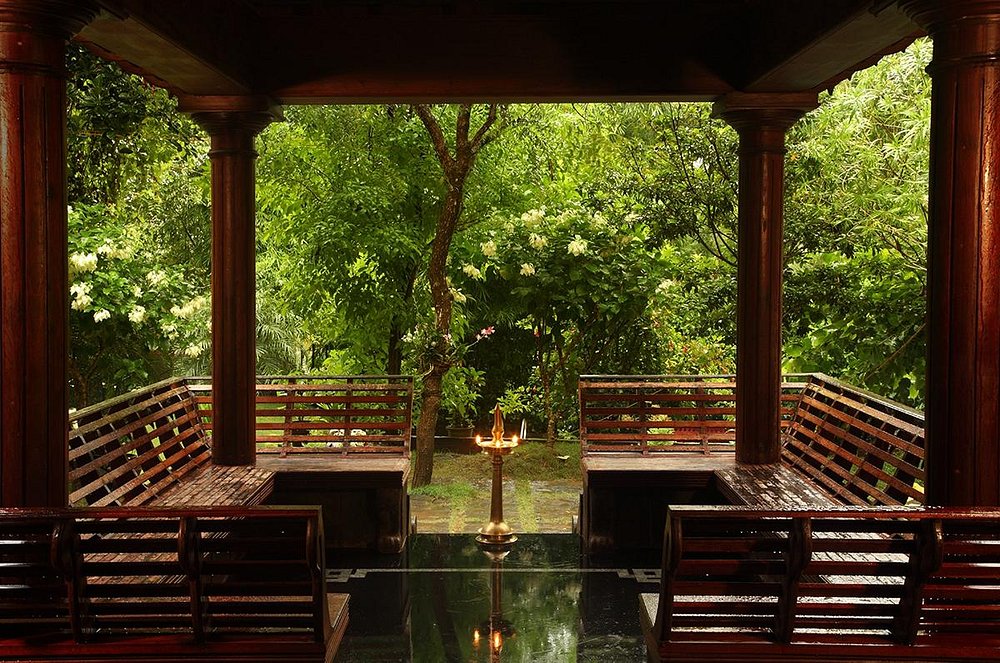
If your thoughts run in loops — rehearsing yesterday, bracing for tomorrow, rarely resting in now — you already know that telling yourself to "just relax" does not work. A silent retreat for anxiety takes a different route. Instead of arguing with the mind, it gently removes the noise that keeps it spinning: the pings, the small talk, the endless inputs. In the quiet that remains, an overthinking mind finally has room to settle.
At Amrutham, our Signature Silent Retreat is built around this simple idea. Here in Kovalam, Kerala, near the still water of Vellayani Lake, we hold space for silence, structure, and breath to work together — not as a cure, but as a kind, traditional way to help a racing mind come home to itself.
Why a silent retreat for anxiety begins with fewer inputs
Anxiety is rarely a shortage of thinking. More often it is too much of it — the same worries circling, faster and louder, with nowhere to land. Every notification, conversation, and decision is another input the nervous system must process. When inputs never stop, the body stays subtly braced, as if something always needs watching.
Silence interrupts that pattern at the source. With fewer things to react to, the mind slowly runs out of fuel for its loops. This is the quiet logic behind a silent retreat for anxiety: you are not forcing calm, you are simply removing the constant stimulation that makes calm feel impossible. Many guests describe the first surprise as relief — the realisation of how much effort ordinary noise was quietly costing them.
The nervous-system logic of silence
There is a gentle physiology to this. When stimulation drops and the breath slows, the body can ease out of its alert, fight-or-flight state and into the "rest and digest" mode governed by the parasympathetic branch of the autonomic nervous system. Heart rate softens, the shoulders drop, and the mind's grip loosens a little. None of this is mystical — it is the body doing what it is designed to do, once we stop interrupting it.
In Ayurveda, this restlessness is often understood as aggravated Vata (the air-and-space energy linked to movement, change, and anxious thought). Practices that bring warmth, rhythm, and grounding — slow meals, oil massage (Abhyanga), and the steady warm stream of Shirodhara — are traditionally used to settle exactly this quality. Silence is the container that lets all of it actually land.
How structure makes the silence safe
For an anxious mind, unstructured silence can feel like more space to worry, not less. That is why structure matters as much as quiet. A well-held day gives the nervous system something it deeply wants — predictability — so it can finally stand down. You always know what comes next, which means there is nothing to anticipate and nothing to decide.
Our days follow a gentle, repeating rhythm rather than a packed schedule:
- A grounding morning: gentle yoga and seated meditation to begin in the body, not the inbox.
- Therapies that calm: classical Ayurvedic treatments chosen to soothe an overactive system, woven into the day.
- Sattvic, vegetarian meals: warm, simple, nourishing food eaten in quiet, which itself becomes a meditation.
- Unhurried space: time by the lake, in nature, with no agenda to perform and no one to answer.
Within that frame, silence stops feeling like deprivation and starts feeling like permission. You can read more about how we shape these days on our retreats overview.
Breath: the one input you keep
When we take away so much, breath becomes the thread you hold. It is the one tool always available, and the most direct line we have to the nervous system. A slow, extended exhale is a quiet signal to the body that it is safe to soften — which is why breathwork (Pranayama) sits at the centre of the experience.
You do not need to be flexible, spiritual, or "good at meditation" to benefit. You simply learn to notice the breath, lengthen it, and return to it whenever the mind wanders off — which it will, often, and that is fine. This is also the heart of our wider Prana programme, which pairs Ayurveda with yoga and breath, for guests who want the same grounding work in a less strictly silent form. The skill you build is portable: the breath you find here is the breath you take home.
What to realistically expect from a silent retreat for anxiety
Honesty matters here, so let us be clear about the shape of it. The first day or two can feel strange, even louder inside, as the mind notices the silence and protests. This is normal — and it usually passes. What tends to follow is harder to put into words: a slowing, a spaciousness, a sense of the gaps between thoughts widening. Most guests leave feeling clearer, calmer, and more grounded, carrying a few simple practices they can actually keep.
What a silent retreat for anxiety is not is a quick fix or a guarantee. Silence may support a more settled mind; it does not erase the causes of anxiety, and it is not a substitute for medical or psychological care. If you live with clinical anxiety, panic, or any diagnosed condition, please treat a retreat as a complement to professional support — not a replacement — and speak with your doctor or therapist before you come. We are glad to talk through what the experience involves so you can decide what is right for you.
A quiet sanctuary, by design
Some of what helps an anxious mind is simply the setting. Amrutham is intentionally small — only eight rooms — so the property itself stays calm, unhurried, and personal. There are no crowds to navigate and no performance of wellness, only nature, care, and the slow rhythm of days that ask nothing of you. It is the kind of place where silence feels held rather than imposed.
If your mind has been running too fast for too long, this is an invitation to take the U-turn inward — to trade noise for stillness, effort for ease, and overthinking for breath. Come and let the quiet do its gentle work.


