
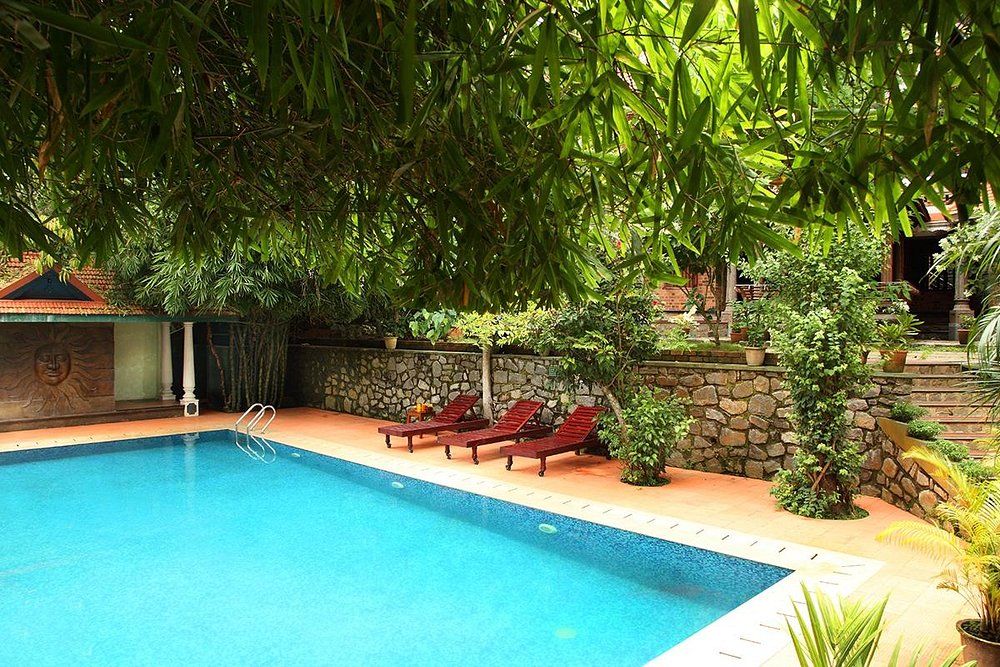
There is a particular tiredness that arrives the moment you decide to train as a yoga teacher — not of the body, but of logistics. Where will you sleep? What will you eat after a long morning on the mat? Can you afford to step out of ordinary life for a month and trust that you will be looked after? At Amrutham, in the quiet near Vellayani Lake in Kovalam, we have come to believe that the question of yoga teacher training accommodation and meals is not a footnote to the syllabus — it is part of the teaching itself.
A month of training asks a great deal of you. The hours are early, the practice is honest, and the philosophy slowly rearranges how you see your own mind. What surrounds those hours — your room, your plate, the rhythm of the day — either supports that work or quietly drains it. We would rather it support you, so that you can give your attention to what matters.
Why yoga teacher training accommodation and meals shape your learning
Yoga is not only what happens during asana practice. The classical texts describe it as a whole way of living — and the lineage of Hatha yoga, the physical and energetic practices most teacher trainings draw upon, has always been bound up with diet, rest, and a settled environment. When you are well-housed and well-fed, the nervous system stops bracing. You sleep more deeply, recover faster between sessions, and arrive at each morning's practice with something to give rather than something to protect.
This is why we treat the surrounding care as inseparable from the curriculum. The thoughtful provision of yoga teacher training accommodation and meals means you are not negotiating with distraction — you are free to be present. A trainee who is anxious about the next meal or restless in an uncomfortable room cannot easily learn to hold space for others. The calm you will one day offer your own students begins with the calm you are given here.
Where you will rest: an intimate place to live and study
Amrutham is deliberately small — only eight rooms — and that scale is a choice, not a limitation. A large training school can feel like a campus you pass through; ours feels like a home you settle into. For the length of your course you are not a guest checking in and out, but someone who lives here, walks the same garden paths each dawn, and grows familiar with the light on Vellayani Lake.
- Quiet over spectacle: nature-immersed rooms meant for genuine rest, away from the noise of the tourist strip.
- A settled rhythm: living on-site means no daily commute eating into your study, your practice, or your sleep.
- A small cohort: with so few rooms, the group stays intimate, and the teaching can stay personal.
- Proximity that matters: about thirty minutes from Trivandrum (Thiruvananthapuram) international airport, yet wrapped in stillness.
You can read more about how we think of the property and our philosophy on the page about Amrutham, where the M·A·Y approach — Meditation, Ayurveda, Yoga — is woven through everything, including the room you will call yours for the month.
What you will eat: sattvic food as part of the practice
Few things shape a month of intensive training as quietly and as powerfully as the food on your plate. Our kitchen is wholly sattvic — vegetarian, fresh, and gentle — drawing on the Ayurvedic understanding that what we eat becomes not only our tissue but our temperament. Heavy, over-stimulating food clouds the mind; clean, well-prepared food keeps it clear.
In Ayurveda, the strength of your digestive fire (agni) governs how well you absorb both nourishment and experience. A sattvic diet is traditionally used to support steady energy and a settled mind — exactly the conditions you need to memorise sequences, hold long meditations, and study philosophy without burning out. You will not find stimulants pressed on you here, nor the rich excess of a resort buffet. You will find food that helps you practise.
- Vegetarian and seasonal: simple Kerala cooking that honours the body without weighing it down.
- Timed to the day: meals that fit the early mornings and reflective evenings of a training schedule.
- Rooted in Ayurveda: food chosen to support, gently, a clearer, calmer, and more grounded mind.
A day in the life of a trainee
When accommodation and meals are held with care, a training day has a natural shape. You wake before the heat, gather for early practice, and break for nourishment that has been prepared for the work ahead. The hours of study, anatomy, teaching methodology, and self-practice unfold without the friction of having to fend for yourself. By evening you return not to a strange hotel but to a familiar room, with the day's learning still settling in you.
This continuity is the quiet gift of training where you also live. The structure of our Yoga Teacher Training is built so that the day carries you, rather than the other way around. For those who wish to deepen their practice before committing to a full teacher's course, the gentler Yoga package offers a way to taste this rhythm first.
Practical questions worth asking before you book
Choosing where to train is a serious decision, and you deserve honest answers before you arrive. When you compare programmes — ours or any other — it is worth asking the same grounded questions, because the answers reveal how seriously a school takes your wellbeing.
- Is everything on one site? Living, learning, and eating in one place removes hidden costs and daily fatigue.
- What does the Tuition include? Clarify whether yoga teacher training accommodation and meals are part of the course, so there are no surprises.
- Can the food meet your needs? If you have dietary requirements, ask early — a thoughtful kitchen will want to know.
- How large is the group? Smaller cohorts usually mean more individual attention and a calmer place to live.
If a teacher's path feels like too large a step for now, you may find that exploring our yoga offerings more broadly helps you understand what you are looking for. There is no rush, and no wrong order in which to begin.
A month to return to yourself
A yoga teacher training is, in the end, a long U-turn inward — a return to yourself by way of the practice you will one day pass on. We cannot make that journey for you, but we can make sure the ground beneath it is steady: a quiet room, a nourishing plate, a small community, and the unhurried rhythm of a place built for inner work rather than display.
If this is the kind of training you have been hoping to find, we would be glad to welcome you to Kovalam — and to show you, in person, how much gentler the path becomes when you are truly looked after.


